
Virtual Class Trip

Using iDevices, class 6b have been on a virtual field trip to various global destinations. Their job was to investigate the destinations in order to write a travel guide. I pushed the lesson to all the class using Dropbox, in groups the children then read the learning objectives and discovered their destinations (New York, Rio or Moscow).

I had already asked the children to download relevant apps for their cyber-journey (world travel guides, aroundertouch, upnext 3D cities, easy atlas, google earth etc). At first children simply explored their respective cities interactively. We then spent time looking at examples of interactive travel-guides and their content.

We made a comprehensive list of areas of expertise (hotels, restaurants, nightlife, travel, phrases, do’s and don`ts, currency, must see places etc), the children then chose their preferred area of study and started their detailed research. Some chose to take notes on their iDevice whilst others straight onto a Laptop. Working both independently and collaboratively, the children then completed the research and moved onto another subject area.

Eventually, using MS Publisher their notes were re-written and they created their travel guides. Using ‘FlipSnack’, we then converted the Publisher Files to interactive books which you can see below (with Flash). It was the first real test of the children being completely in charge of their own learning using the iDevices. I was able to facilitate the proceedings whilst the children were mature,  able and motivated enough to produce some outstanding travel guides that they can be extremely proud of.

<a href=”http://www.flipsnack.com”>Flipsnack </a>
iPods and iPads in Year Six

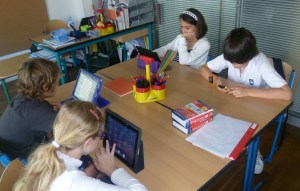
On Friday, class 6B brought in their i-devices and we experimented with them as learning tools in the classroom. Each child established a dropbox account to which I pushed the lesson. It was amazing, they were instantly engaged in their learning, without me saying a word (no turning on computers, logging in etc helped as well). Next, in groups, the children simply followed the instructions to research a selection of school blogging sites from the UK to see what the content was like. Some of the class were so impressed with what they read that they were compelled to comment on the blogs instantly.

Following a class feedback session and break time, the children undertook their next task – to research apps that may be suitable for school usage. Three different groups investigated English, Science and Maths apps, and then posted their findings back into dropbox for a whole class plenary at the end of the lesson. It was amazing; complete engagement for all the children throughout. This was coupled with great teamwork as the children picked different areas within their chosen subject area to focus on. One child even solved the ‘How to save to dropbox from an iPad/Pod’ question. Take a screen snap shot and save it as a photo! I would never have thought of that! All in all a very successful first idevice lesson and later this week we will be using them to go on a ‘Virtual Field Trip’! Watch this (cyber)space…

iPods and iPads in the classroom

A group of representatives from ISM, including myself, have just returned from a fascinating trip to the UK and Norway, in which we were able to see some outstanding schools where iPads and iPods are being used to enhance learning.

The first school we saw was the ESSA Academy in Bolton. The staff and kids from ESSA were a real inspiration. The shared vision was quite extraordinary; from the way the intuitive curriculum was organised to the 1-2-1 allocation of iPod touches, everything at ESSA was very forward thinking and aimed at achieving the higest possible standards for the children. The results of the school’s GCSE’s over the last 3 years in fact proved that the vision was working, exceptionally well – in 2008 30% of their children acheived 5 or more GCSE’s A*-C, the figure acheiving that now is 70%…

We then flew to Stavanger International School, via Copenhagen where the project was slightly different. Similarly, the school was using iPod touches as a day to day classroom resource, although the allocation was not yet 1-2-1. Stavanger also has iPads in the classroom, and we were able to see first hand their potential as we walked into a year 1 classroom in which the children were literally using iPads for the first time. Within munites they were loading apps, drawing pictures, writing words and reading. Incredible.

Our final destination was Bowes Primary School in London, where again iPads and iPod touches were regularly being used by the children. We saw them being used in a variety of different contexts; in one y5 class the children were acting scenes from Romeo and Juliet, taking photos and then adding speech and thought bubbles in Old English to a comic strip! This was happening in a matter of seconds.

A huge thank you to all three schools, whose hospitality, advice and knowledge were outstanding and incredibly motivating. Whenever we saw the devices being used, we saw engagement, collaboration and learning. Food for thought for all involved and certainly an inspiring and exciting glimpse into what the future holds for education. A future, that is not what it used to be…

New Blogging Site Up and Running!

Well, how appropriate that the first blog on the ICT development site should be about the new blogging site! After a few months of planning and with some great support from Heathfield Primary School and Creative Blogs, The International School of Monaco finally has a blogging site all of its own. Still very much in its infancy, the site will hopefully provide the ISM community to share their news, thoughts and ideas with the rest of the world.

Year Six became the first contributors to the site today when they blogged about their recent trip to Verbier, Switzerland. I hope as many people as possible get a chance to read them; please feel free to share your comments with us.