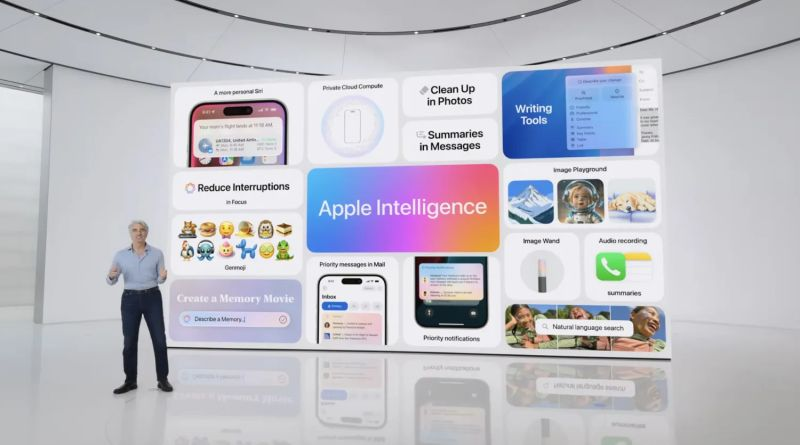
As Apple Distinguished Schools the RGS Worcester Family of Schools are evaluating Apple’s recent AI announcement with interest…
With the forthcoming release of iOS 18, generative hashtag#AI features, dubbed Apple Intelligence, will be integrated into Apple’s products (with a little help from OpenAI). The features include proofreading & rewriting documents, generating images, transcribing voice memos, summarising emails & lectures, automated film production & problem solving in maths. While these advancements offer possibilities to augment learning & teaching, they will also present a variety of challenges…
✅ Benefits Apple Intelligence will significantly enhance some of Apple’s learning tools. The AI writing assistant & the new calculator app are particularly noteworthy. For example, the AI writing assistant could offer instant feedback on grammar & style, helping students improve their writing skills in real-time. Furthermore, the calculator app could guide students through complex maths problems with tailored hints & explanations, providing a more individualised educational experience. AI movie generation will mean students could demonstrate knowledge & understanding via AI produced films, whilst transcribing voice memos could be a real bonus in lessons & lectures as students could easily record & summarise teaching. The transcriptions could then be turned into quizzes or flashcards using tools like Quizizz or Quizlet.
🤔 Challenges There are legitimate concerns about the potential misuse of AI tools for cheating on assignments. Research suggests (Freeman, 2024) that while student cheating has not significantly increased with the rise of AI tools, it remains problematic. Teachers may also be reluctant for students to record their lessons, especially given concerns over deepfakes & privacy. Additionally, increased screen time is a risk, potentially affecting students’ well-being. Another problematic challenge is accessibility, as these AI features are only available on the newest Apple products, limiting immediate access for many schools and students.
🤖 Preparing for the Future The introduction of Apple’s AI features highlights the importance of our AI literacy programme for teachers, students, parents & the wider community. Our teaching approach will need to evolve to balance the use of AI with the development of critical thinking & independent problem-solving skills. Preparing students for an AI-driven workforce is crucial, as employers will increasingly seek individuals adept at using AI tools.
While Apple’s generative AI features hold promise for enhancing education across the RGS Worcester Family of Schools, they also present challenges that require careful consideration. By staying AI literate & adaptable, establishing robust policies & remaining willing to learn, we can leverage these advancements to benefit our students while addressing potential drawbacks effectively.
The emergence of Artificial Intelligence tools like ChatGPT, Google Gemini etc. offer incredible possibilities for learning; a technological leap that could (& will) reshape education. Incumbent within any school technological adoption, particularly with AI, there are of course significant challenges that need careful consideration.
Nevertheless, at RGS Worcester we see inaction as the biggest threat.
Our approach to AI focuses on proactive CPD to build AI literacy across our entire school community – students, staff, & stakeholders. This is backed by a robust AI policy & AUP to ensure ethical, transparent, & effective use of AI.
⭐️ Empowering Educators Through Training & AI Literacy
Regular, bespoke training equips our teachers with the knowledge & confidence to integrate AI tools effectively in their daily practices. This allows them to adapt to advancements, improve efficiencies, while adding value across the curriculum.
⭐️ Building AI Literacy in Students
Our curriculum includes discussions on AI literacy, responsible technology use, & original work. This starts in Year Four with exploring AI assistants like Alexa & Siri. Hands-on experiences like building chatbots in Year Six foster understanding of AI’s capabilities and limitations.
⭐️ Senior School and Beyond
Our Computer Science & PSHCE curriculum now contain schemes of work on AI bias, AI mechanics & critical evaluation of AI outputs. School-wide assemblies & clear communication with parents keep our entire community informed & engaged.
⭐️ Examples of AI Integration at RGSW
AI-powered platforms like SchoolOnline.AI & sAInaptic support assessments, offering personalised feedback & practice opportunities whilst AI quizzing apps such as Quizizz & Socrative generate questions & provide immediate feedback to gauge understanding & adjust learning strategies. Canva is used for content productions & to spark critical thinking by prompting students to analyse AI-generated visuals & storyboard key concepts. Some pupils are using bots like Mindjoy to assist with revision. Knowing how LLM’s work, means we maintain a healthy scepticism of AI output.
⭐️ The Human Touch Remains Irreplaceable
While AI can support learning, it can’t replace the empathy, inspiration, & mentorship teachers provide. However, educators need time & training to leverage AI effectively alongside human-led instruction.
⭐️ Bridging the Digital Divide
We understand the digital divide & are committed to equitable access. We deliver AI CPD & assemblies at other schools, sharing our insights and methods to help them integrate AI effectively.
The integration of AI into education is as transformative as the dawn of the internet. At RGSW, we’re preparing our students for a future where AI is ubiquitous. By embracing change, fostering ethical considerations, & continually adapting, we’re equipping them with the skills and knowledge to thrive in a future where AI will play an ever-increasing role.
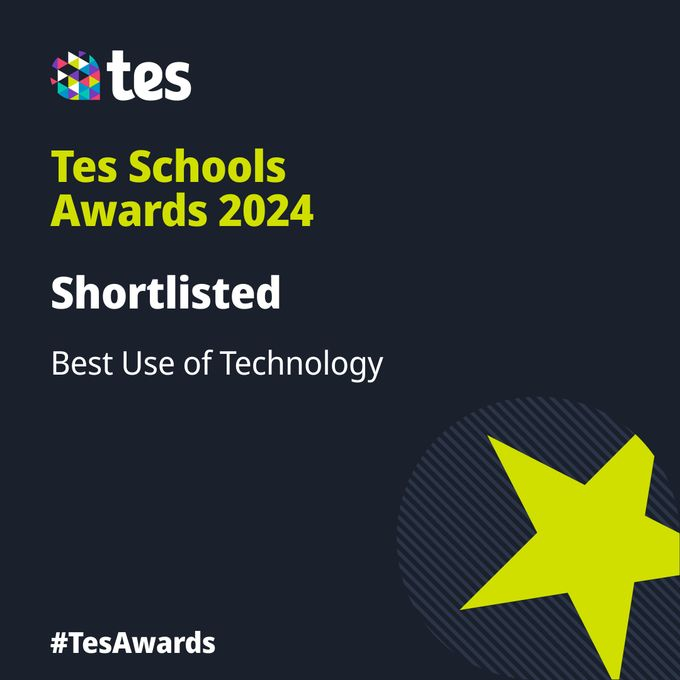
Delighted to share that The RGS Worcester Family of Schools has been shortlisted in the TES awards 2024 as a finalist in the category ‘Best Use of Technology’.
Our digital culture has helped to cultivate a strategic approach to adopting Artificial Intelligence. Our holistic AI literacy programmes have provided the foundations from which we have adopted AI meaningfully and ethically, where appropriate, across the curriculum.
This shortlisting is recognition for our entire school community who all help to ensure that the RGS Worcester Family of Schools remain at the forefront of meaningful innovation, whilst preparing our learners for an increasingly digital world.
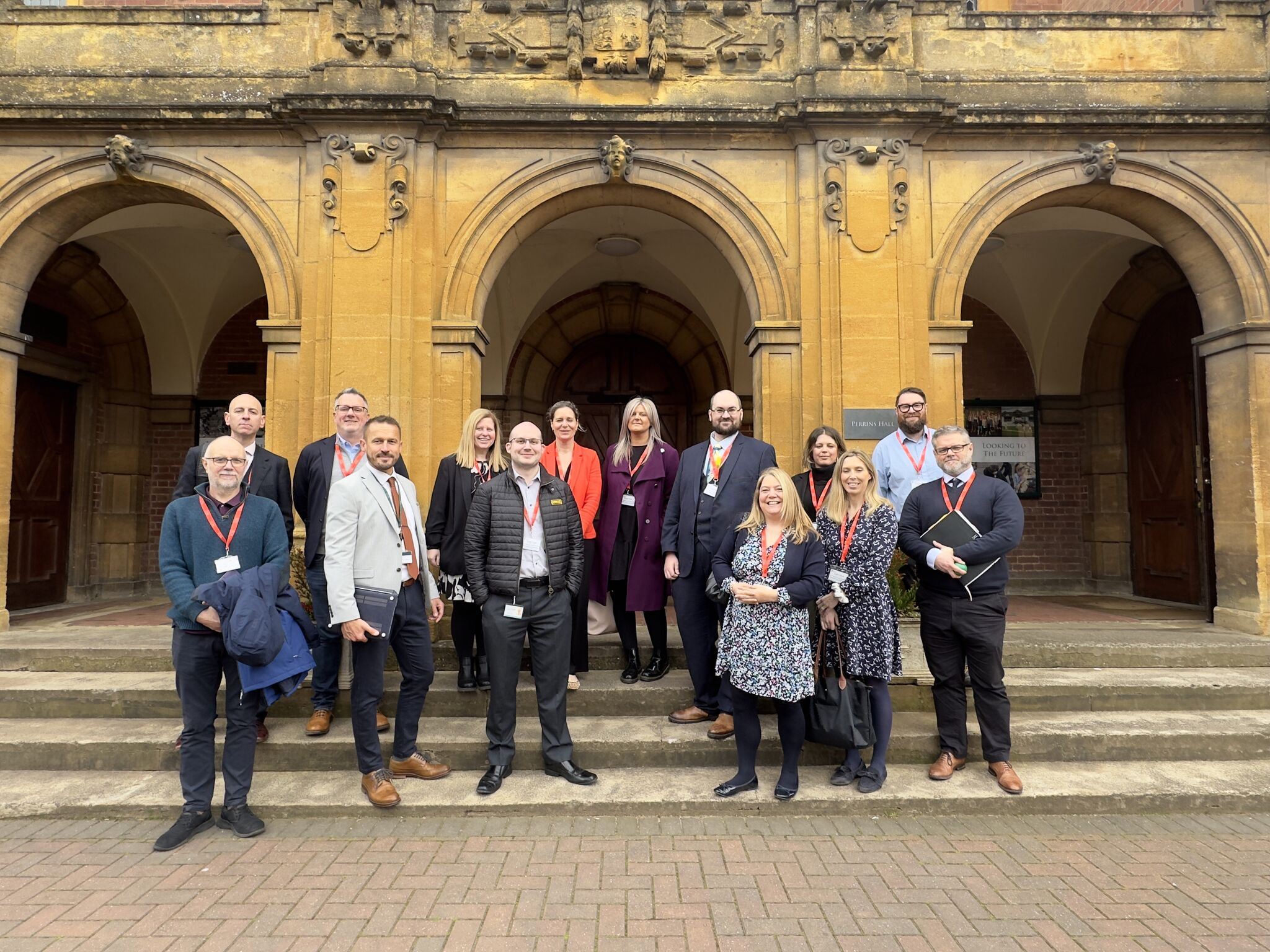
Just wrapping up a brilliant day at RGS Worcester and RGS The Grange where we hosted our second Digital Learning ‘Study Tour’, in association with the West Midlands hashtag#EdTech Hub & as an Apple Regional Training Centre.
After an incredible opening presentation from one of our pupil ‘Digital Genius’ representatives, the tour began at the Senior School to observe how technology was integrated across the curriculum where it added meaning and value. The Textiles, English, Science, and Computer Science depts all showcased how digital technology could enhance, augment, and enrich learning in conjunction with traditional teaching methodologies. En-route, teachers discussed how digital tools were reducing workload, personalising learning, improving feedback and also streamlining organisation.
The next stop was RGS The Grange where Headmaster, Gareth Hughes, and Head of Computing & Digital Learning, Matt Warne, highlighted the transformative journey the school had undergone to position itself at the forefront of digital learning and innovation in Prep education.
Our visitors then embarked on a tour across the Key Stages to observe the impactful use of technology across various subjects, reflecting both variety in application and depth in integration. Pupils and teachers consistently displayed outstanding digital proficiency, reinforcing that digital technology is not merely a novelty but a fundamental aspect of classroom practice that, when used appropriately, can enhance the educational experience.
Post-lunch, the agenda featured a ‘Q and AI’ Session, including a Mentimeter survey discussing schools’ approaches to hashtag#AI, followed by a Q & A with staff before we said our farewells.
A HUGE thanks to all the staff across our schools who opened their classrooms for the Study Tour. Special appreciation also goes to the catering, marketing, event-planning, and maintenance teams for ensuring the day’s success. Thanks also to our pupils for sharing their experiences so eloquently and to our guests, who are always welcome back to our Family of Schools.
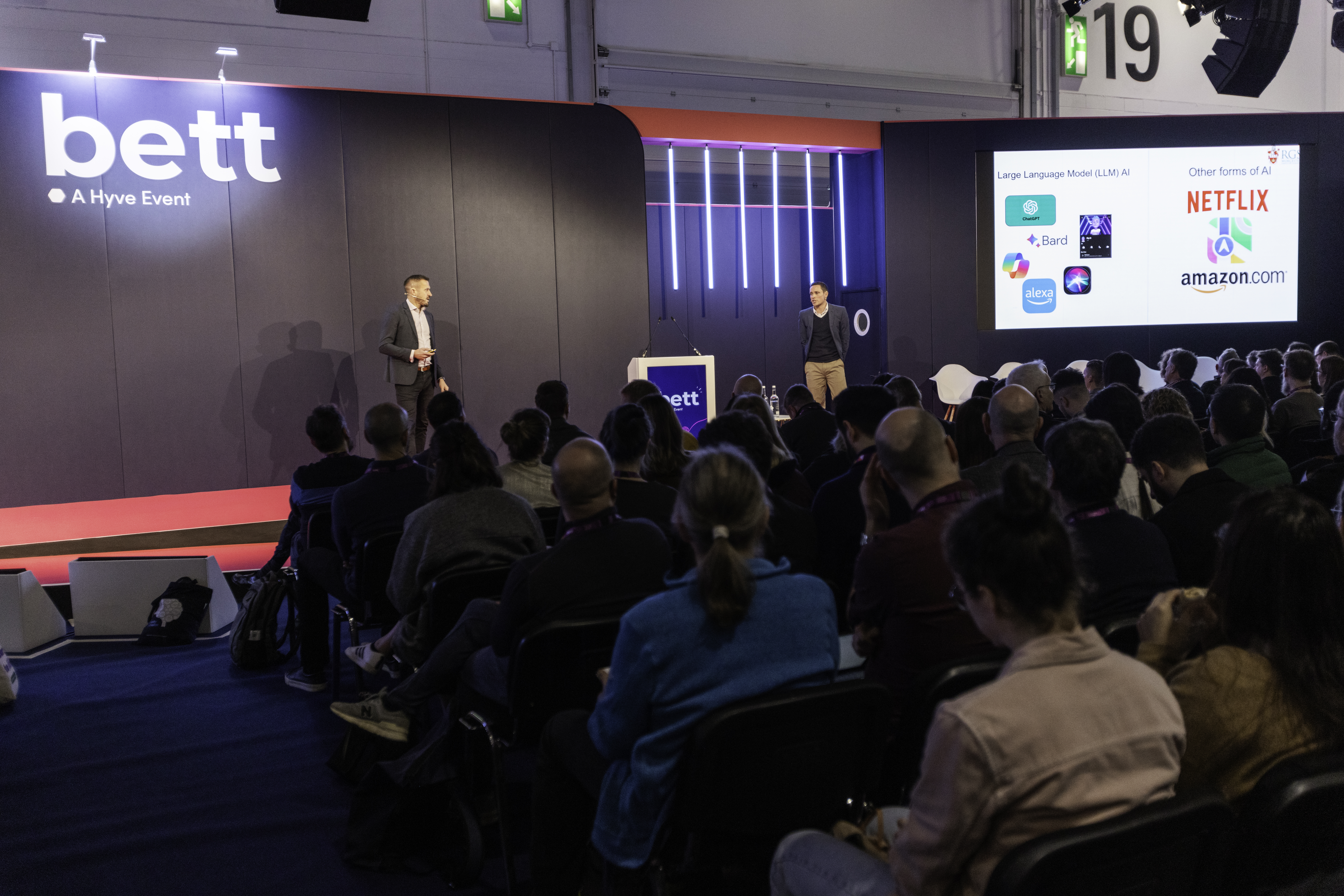
Bett Global – London – 2024 came to an end on Friday. Once again, it proved to be a brilliant event, packed full of new software, hardware and solutions for education. However, as ever it is the people that makes Bett extra special.
On Wednesday, I participated in a ‘Table Talk’ that sparked fantastic conversations about generative hashtag#ArtificialIntelligence in education. It was very useful to sit down with a group of educators to talk and share experiences on a topic that is challenging all of us to think differently. After the show, I had the privilege of attending the hashtag#bett2024 Awards as a judge and seeing some of the best hashtag#EdTech companies gain recognition for the work they do and products they make.
On Thursday, I was joined in London by friend and colleague Matt Warne as we were presenting together, in the Teaching and Learning Theatre, on the RGS Worcester Family of Schools’ Whole School Approach to hashtag#AI. It was a bit of a dream come true to represent RGS Worcester at Bett and share our story to a packed Theatre. Indeed, it was an experience neither of us will forget. Hopefully, it proved to be an authentic, useful and meaningful experience to everyone who took the time to come along.
Friday was the turn of the pupils! Over 40 children from all four of the RGS Worcester Family of Schools made it down to East London. They had tasks to complete; ranging from selfie’s with Robots to testing out and reviewing the latest E-Sport technologies. However, the highlight of their day was presenting on the Albion Computers PLC stand alongside RGS The Grange’s very own Adam Morgan. They shared how AI Literacy was being developed across our schools and a huge audience gathered to listen to their insights and of course, they did themselves and the school extremely proud.
So, that’s it for another year as far as the Bett Show is concerned. However, between now and Bett 2025, it is clear that the educational landscape will continue to change, perhaps quicker than ever before. AI was everywhere, but it’s important that the educational community sift through the noise and identify what is actually adding meaning and value to teaching and learning. Hopefully, RGS Worcester will be back next year to share what more we have learned as we navigate the challenge of getting the very best out of hashtag#EdTech.
Recently, I happened across a newspaper article titled ‘Top 5 most in-demand soft skills.’ My instinct was to snub the column as although not new to the term, my blasé interpretation of ‘soft skills’ gave them little significance. However, I immediately reconsidered my rebuttal. Perhaps my ignorance on this subject required deeper questioning rather than overlooking? I returned to the original piece with a fresh pair of eyes and my quest for soft skill related knowledge was underway…
First and foremost, what precisely were ‘soft skills’ and what made them soft? Inevitably, my mind had also raced to the existence of their presupposed nemesis, ‘hard skills’ and why were they hard? Were there any medium, firm, supple or even spongy skills that were either in-demand or highly unpopular? It turns out the term ‘soft skills’ surfaced in the US Military, somewhere between 1968 and 1972. The military had successfully trained troops to use machinery, but still observed a difference between group performance. They coined the term ‘soft skills’ to define the skills that were variables in achievement, that didn’t involve interaction with machines. Nowadays, soft skills have taken on a broader meaning. The online Cambridge Dictionary simply describes soft skills as ‘people’s abilities to communicate with each other and work well together’. Wikipedia provides a more enlightening definition: ‘skills which are desirable in all professions’ and also shared the contrast with hard skills, which were ‘specific to individual professions.’
Whether opting for Cambridge or Wikipedia’s take, it seems to me that ‘soft skills’ could be in need of a re-brand. After nearly dismissing the article, because of my own negative preconceptions of the term, further investigation revealed how remarkably important they all seemed! Creativity, persuasion, collaboration, adaptability and emotional intelligence are clearly desirable, and also qualities that many aspire to equip themselves with. Yet, by calling them ‘soft’, these skills appear fluffy and we devalue their importance, especially when considering that, according to the University of Michigan, companies who focus recruitment on soft skills develop higher levels of productivity. Indeed, according to LinkedIn’s 2019 Global Talent Trends, 92% of managers agreed that soft skills are just as important, or more important than hard skills.
One of the key factors driving this increased value of soft skills in the jobs market is technological disruption, specifically the exponential growth of robotics, artificial intelligence and machine learning. Contrary to popular opinion, these remarkable technologies are not replacing existing occupations, rather they are superseding specific tasks – or to put it another way, ‘hard skills’. Furthermore, the COVID-19 pandemic has driven many organisations and businesses to the virtual world to ensure operations continue despite isolations and lockdowns, super-charging the change process.
For example, customer service departments increasingly use chatbots and automated messaging solutions. Whilst in HR, automation is transforming hiring, onboarding and retention. Common tasks are rapidly being replaced by cost-effective automated alternatives that leave professionals with more freedom to focus on creativity, collaboration and the exploration of innovative ideas. In other words, because they cannot be substituted by technology, demand for ‘soft skills’ are on the rise. However, according to Forbes, there is an issue with supply; 54% of British businesses claim soft skills are ‘difficult’ to find in candidates, whilst 51% of those surveyed admitted this was damaging business growth.
All this leads to a glaring quandary for us educators. As employers increasingly search for attributes such as resilience, teamwork and empathy, modern UK school curricula tend to focus on teaching hard skills such as mathematics, writing, programming, reading and design. As a direct result of this paradox, the Education Commission estimates that by 2030 over half of the world’s young people will not possess all the necessary skills to participate in the emerging global workforce.
So, what can schools do to ensure their pupils develop the skills that will be a prerequisite of tomorrow’s workplace, whilst still ensuring they attain the best possible grades in GCSE and A-Level examinations? A global rebrand of the ‘soft skills’ misnomer is, sadly, unlikely. However, developing a comprehensive PSHE programme has proved a useful starting point at RGS Worcester. Pupils build resilience, learn to navigate the treacherous social media landscape, understand and look after mental health and learn to develop positive relationships. Soft skills also have a place in our specific curriculum subjects, working not instead of, but in conjunction with, the acquisition of hard skills. Teachers create activities that put an emphasis on group work, time management and peer-on-peer collaboration. Our Digital Learning Programme provides exposure to digital workflows, real-time communication and facilitates the attainment of skills such as independent research, and presentation packages. Furthermore, a rich co-curricular programme including activities such as debating, the Duke of Edinburgh Award and the Combined Cadet Force mean RGS Worcester pupils naturally develop teamwork, emotional intelligence and empathy. There are also a growing number of digital tools that teachers utilise to help sustain and develop key competencies; Barclays Life Skills, the Inspiring Digital Enterprise Award, Farming STEMterprise are to name but a few.
Ultimately though, the UK education system remains focused on exams and grades. Routine assessment of self-awareness, self-control and empathy is still a very long way off. However, it is important to remember that investing time to teach and understand soft skills will not be lost, far from it. Those who are best armed with strong soft skills, alongside top grades, are much more likely to achieve in the ever changing, complex and challenging world into which they will soon be searching for employment.
On Friday 9th October 2020, the ‘EdTech Vision 2025’ report was published by the EdTech Advisory Forum in response to the Educational Select Committee’s request for views and evidence on the ‘The Impact of Covid-19 on education and Children’s Service’. The report celebrated both the tenacity and resourcefulness of teachers, support staff, schools and colleges from across the UK as they dealt with the challenges thrust upon them due to COVID-19. Furthermore, the report called for an end of governmental indecision towards Educational Technology whilst requesting the development of a dedicated Office for EdTech.
Schools with pre-existing digital deployments were cited as being at an advantage when moving to remote learning. Indeed, we are proud to report that the paper featured the RGS Worcester Family of Schools as an example of how embedded digital strategy and culture meant that we were successfully able to mitigate learning loss. The report used triangulated data, collated by RGSW at the end of the Trinity term, that proved our pupils had continued to progress in interactive and engaging remote lessons, facilitated by our Digital Learning Programme.
“…at RGS Worcester 97% of teachers and 93% of pupils agreed that they had been able to continue to progress when using technology to learn remotely. These figures are replicated in their other schools too. They also discovered that the unprecedented circumstances had also resulted in a dramatic digital up-skilling of both teachers and pupils whilst increasing their confidence to further embrace and utilise digital technology at school”
To be mentioned as a leading UK example of digital learning in the corridors of power in Westminster is really quite something for RGS Worcester. Although we cannot claim to have foreseen a global pandemic, having our Digital Learning Programme in place meant we did have an opportunity to keep learning alive for every single one of our 1300+ pupils when schools across the UK went into Lockdown. We have embraced digital technology for a number of years, knowing that a digital deployment would help prepare students for the digital world in which we all live. Our Digital Learning Programme began in 2014 and means that all pupils from y1-y13 have a personal iPad whilst all our teachers have an iPad and/or a MacBook and as a consequence, digital learning is deeply embedded within our school culture. In a small window before school closure, we re-mapped our Digital Strategy to ensure delivering a full-curriculum remotely became a reality. We designed evidence-informed remote learning models, guidelines and CPD workshops that meant pupils and teachers were fully prepared for remote schooling and would avoid any significant loss of learning. Knowing that another lockdown could be a possibility, we subsequently gathered the data cited in the report to learn what we had done well, but also where we could make improvements.
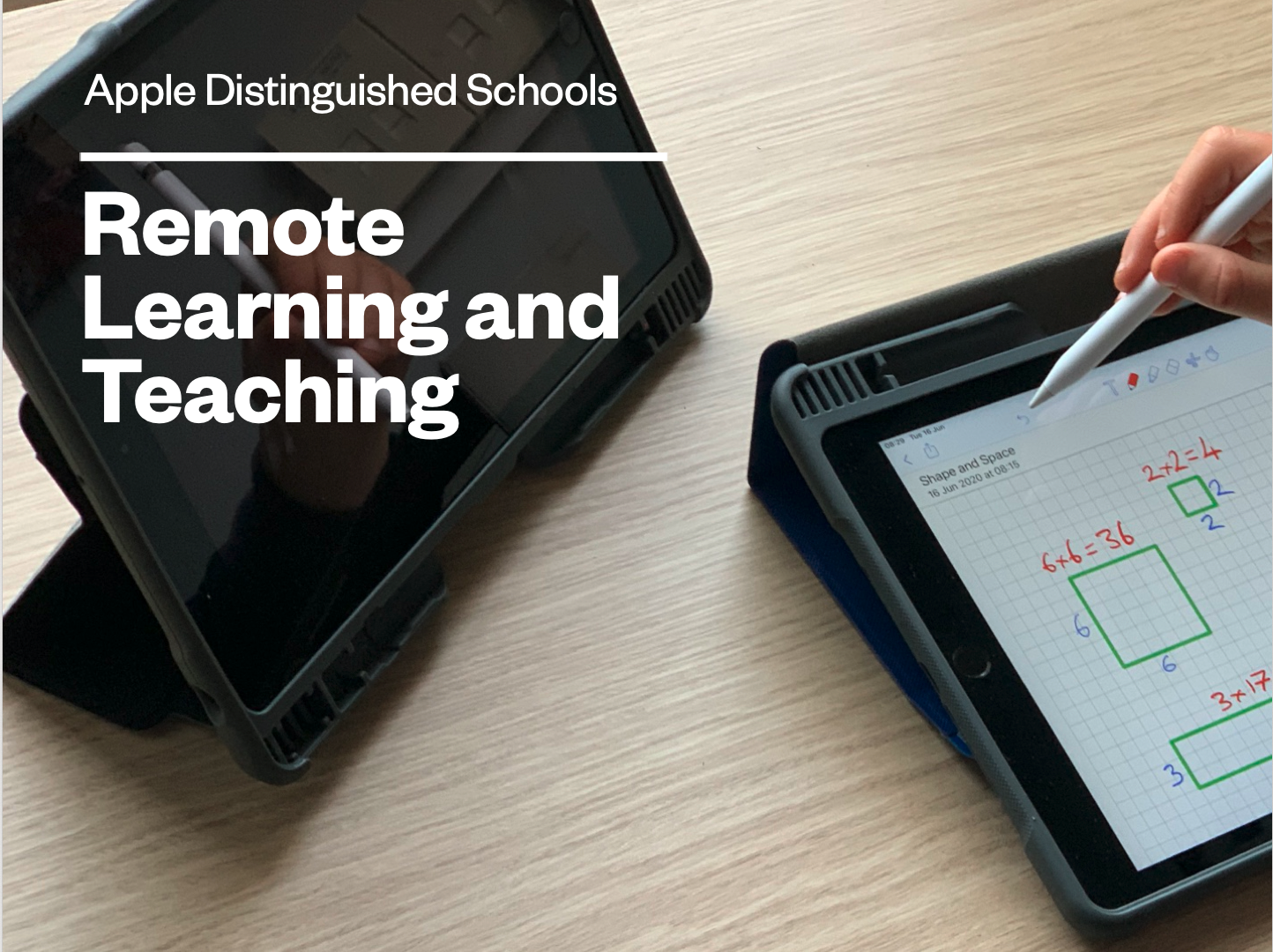
The report goes on to make a number of recommendations including a new EdTech strategy from government that would include infrastructure rebuilds, improved access to devices, further support for digital capacity, capabilities, curriculum and enhanced recognition of the positives of education technology to support teaching and learning. We know how privileged we are at RGS Worcester to already have the digital infrastructure and resources in place to provide outstanding education on-site and indeed remotely. However, we also concur with the recommendations laid out by the EdTech Advisory Forum. Already we have advised a number of schools such as the Bridge School in Malvern, The Windsor Academy Trust in the West Midlands and the Thomas Deacon Academy in Peterborough about developing digital strategy and adopting individual pupil devices. Moving forward, we would also like to offer our support to any other school that is considering adopting digital technology. We also shared our story with a number of other Apple Distinguished Schools in ‘Remote Learning and Teaching’ publication, available on the Apple Book Store. These challenging times offer a real incentive for schools to work together, share good practice and be there for one another as ultimately, we all share the same mission; to ensure learning continues for our pupils and they are able to fulfil their endless potential. Having a holistic and forward-thinking digital strategy goes someway to ensuring that happens.
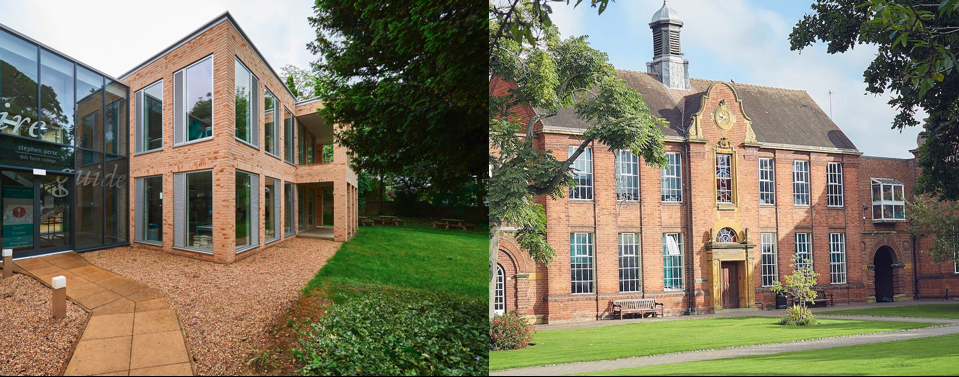
The start of term for teachers normally begins with an INSET day. This involves training, communication about the new school year and ensuring teachers are up to speed with latest safeguarding legislation. At RGSW, we also always reserve some time to disseminate information about our Digital Learning Programme. However, this year I was also tasked with delivering a remote presentation at an entirely different family of schools; The Stephen Perse Foundation in Cambridge.
Like RGS Worcester, The Stephen Perse Foundation consists of a number of schools that provide outstanding education from nursery up to Year 13 in Cambridge. It is also an Apple Distinguished School and was able to provide remote schooling during lockdown. However, over the summer, Stephen Perse contacted Apple as they were felt their staff were suffering a little ‘digital fatigue’ and wanted some inspiration for the new term. Apple immediately thought of RGS Worcester as the perfect school to complete this task and made contact to make suitable arrangements.
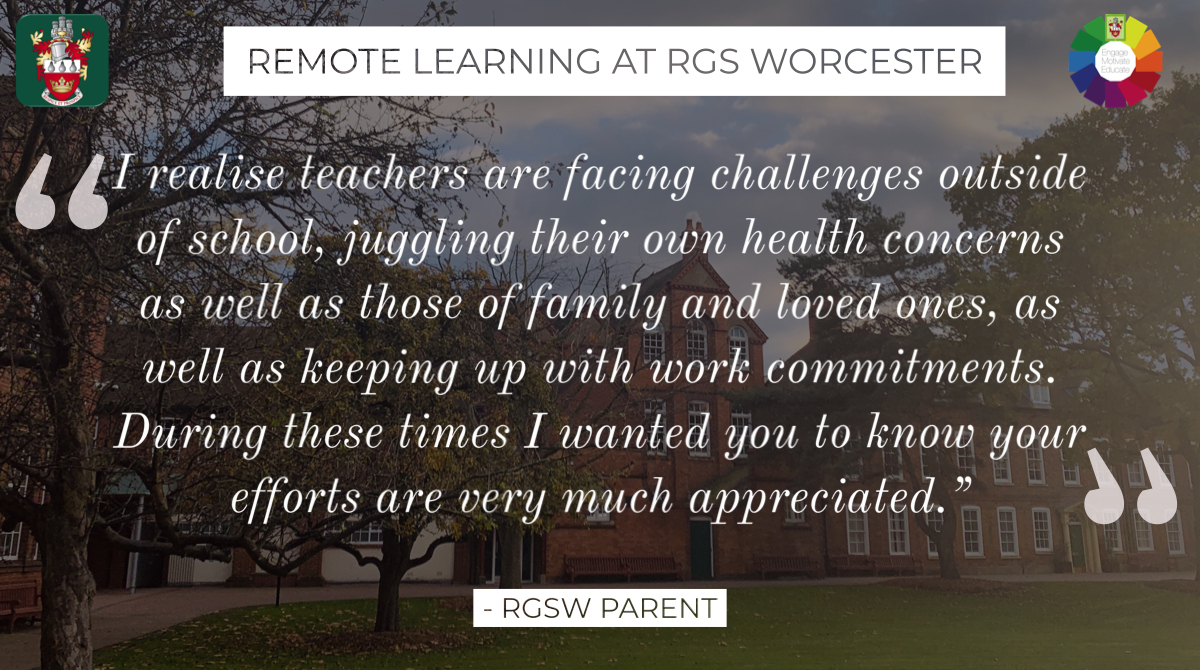
On the 2nd September, using a combination of Google Meet and Nearpod, I delivered a 25 minute presentation to over 150 staff from across the Stephen Perse Foundation, sharing details of our remote learning efforts and some the incredible feedback we had received from parents, pupils and staff. I highlighted that despite the significant challenges represented by COVID, having a digital learning programme meant that learning was not lost and our pupils had been able to continue to progress their studies, collaborate with teachers and peers whilst creating and completing exciting projects and work in a variety of digital formats.
Following the presentation, Vice Principal, Tracy Handford had this to say “The Stephen Perse Foundation was pleased to share reflections on remote learning with John Jones from RGS Worcester. Both schools achieved exceptional uninterrupted provision in the delivery of a full curriculum throughout lockdown through online teaching and learning. As both organisations look towards the challenges of the coming academic year, the opportunity to learn about John’s recent experiences and great resources has helped Stephen Perse staff to recognise that their exceptional efforts and ability to manage challenges were shared by another Apple Distinguished school.”
This challenging times offer a real incentive for schools to work together, share good practice and be there for one another as ultimately we all share the same mission; to ensure learning continues for our pupils and they are able to fulfil their endless potential. Having a holistic and forward thinking digital strategy goes someway to ensuring that happens.
It’s been a summer holiday like no other. The normal end-of-term high-fever, staff BBQ and fond farewells to colleagues and pupils did not happen due to the COVID-19 pandemic. Instead, the start of the vacation blurred awkwardly into the end-of-term as many teachers already found themselves at home following the closure of school sites on March 12th and 20th in Ireland and the UK respectively.
However, contrary to popular opinion, school closures did not spell an early summer holiday for teachers. Rather, for many it signified the start of a remarkable process in which ‘normal’ classroom traditions, customs and practices were turned on their heads. Miraculously, many schools were able to quickly develop and deploy exciting and innovative plans to ensure learning was not lost and students were able to continue to learn whilst at home. Furthermore, those schools that already had established digital learning programmes found themselves at a significant advantage as both students and teachers had the necessary hardware and pre-existing digital skills to make a smooth transition to remote teaching and learning.
I have already blogged about how the RGS Worcester Family of Schools managed to successfully conduct remote schooling but we were not alone in our ability to provide an almost full timetable and co-curricular programme during lockdown. Many other schools within the Apple Distinguished School Community were also able to use their existing infrastructure, hardware and digital culture to ensure high quality learning provision was able to continue.
Towards the end-of-term, a number of those Apple Distinguished Schools put their heads together to compile a digital publication that captures those ideas, practices and stories that emerged from COVID-19 and the need to implement new ways of learning and teaching remotely. Educators and leaders from schools, colleges and universities within the UK and Ireland Apple Distinguished Schools programme have collaborated to share aspects of how they’ve used Apple technology to support learning at home. They also share examples of what they’ve learned, successful practices and ideas for what teaching and learning with technology might look like as a ‘new normal’ when school returns in September and offer a myriad of different possibilities from which we can all learn as we prepare as best we can for an uncertain future.
These last few weeks have been astonishing. The COVID-19 outbreak has forced teachers from across the world, in a matter of days, to come up with plans to keep children learning whilst their schools indefinitely close down. Remarkably, and with no assistance, educators have drawn up radical plans to facilitate the best possible provision for pupils in their respective settings.
Circumstances have been challenging, emotive and provoked much ‘outside the box’ thinking. Nevertheless, educators have joined forces, shared ideas, resources and concepts and as a result, school children across the world have been given opportunities to continue to learn, despite these extraordinary circumstances.
Provision Design and Planning
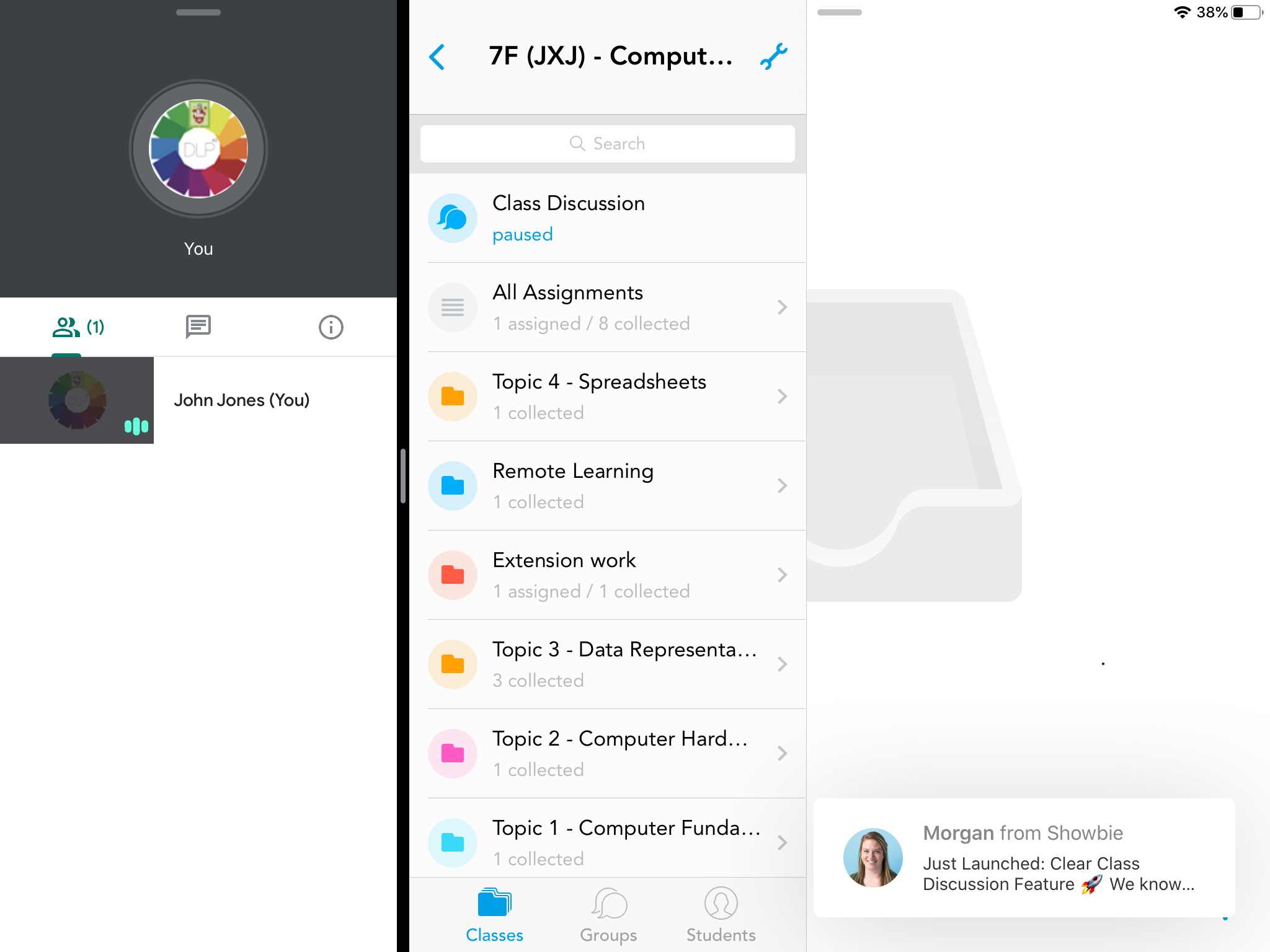
At RGS Worcester discussions and preparations began in earnest three weeks before UK schools were officially closed. Looking at the global picture it was clear that school closure was a distinct possibility and it was vital we needed to be prepared. Our 1:2:1 iPad provision for all pupils from Year Five meant that continuing timetabled academic lesson was possible, albeit remotely. The portability and versatility of iPad, combined with the fact our teachers and pupils are already accustomed to using the device, meant we could develop ambitious plans, safe in the knowledge our Digital Learning Programme (DLP) and status as an Apple Distinguished School provided secure foundations on which to build them. Indeed, considering that both pupils and staff already use Google Accounts; the Computing & IT team quickly agreed that Google Meet would offer the best live-lesson provision. It was also decided that Google Meet should be used in conjunction with Showbie, a workflow solution that most of our academic departments already embrace whilst splitting the iPad screen between Showbie and Google Meet offered a great methodology for remote learning.
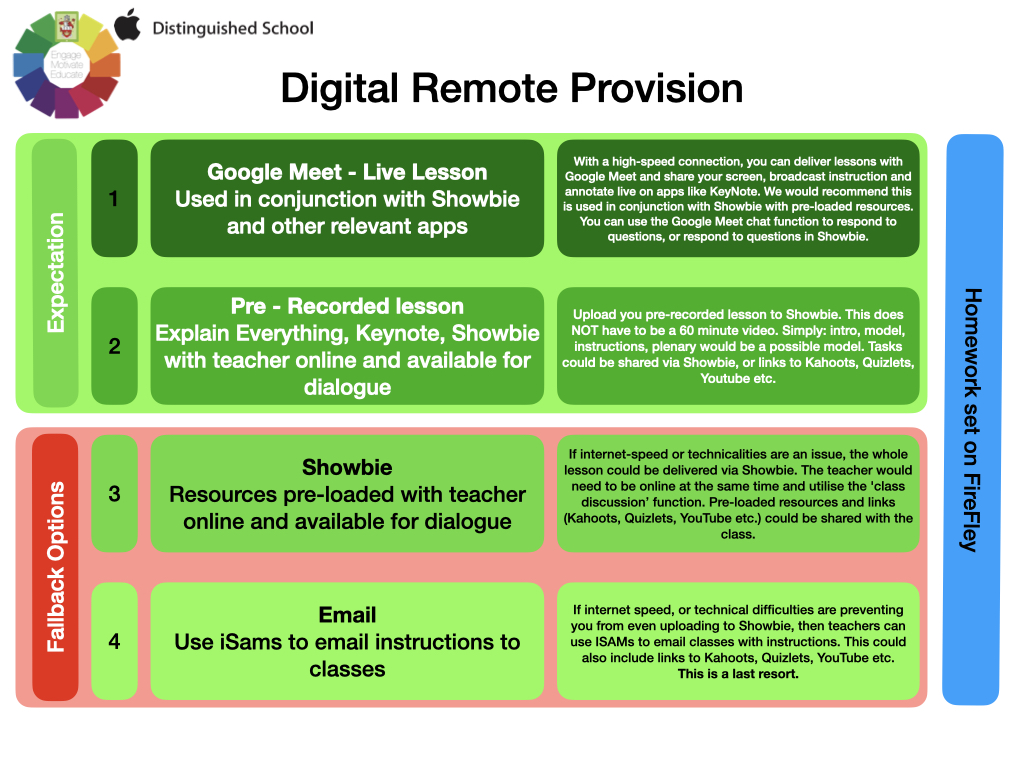
Furthermore, iPad tools such as split-screen view and apps such as Showbie were already familiar to our staff and introducing too many new concepts at this point was not something we wished to burden our teachers with. Our mantra was to keep things as simple as possible. However, we were also aware that not all teachers would be comfortable with teaching live lessons, so an alternative strategy was quickly devised; using Showbie to host pre-recorded lessons whilst a teacher remained online for questioning. There were also two ‘fallback’ strategies should teachers not be available online for whatever reason. This Digital Provision Guide was then put together, outlining the options.
Training For Staff
1. Live lessons
Without being sure when schools were going to close, it was deemed imperative to get teachers trained to confidently teach remotely. We hosted four sessions in four days at which attendance was obligatory. We modelled how to create a meeting in Google Meet, the best way to share invite codes with pupils and how to cast either yourself or your device screen. We showed how the Apple Pencil could be used in conjunction with Apps like Notability and Keynote to become essentially a whiteboard to model learning on. We also demonstrated how pupils could split their iPad screen between two apps so they could follow instructions and work at the same time. We also encouraged staff, in the time we still had at school, to practice using Google Meet with their pupils so all parties had some experience of using the technology before remote learning became a reality. This provided particularly useful as many minor glitches were eliminated and ground rules were established.
2. Pre-recorded lessons
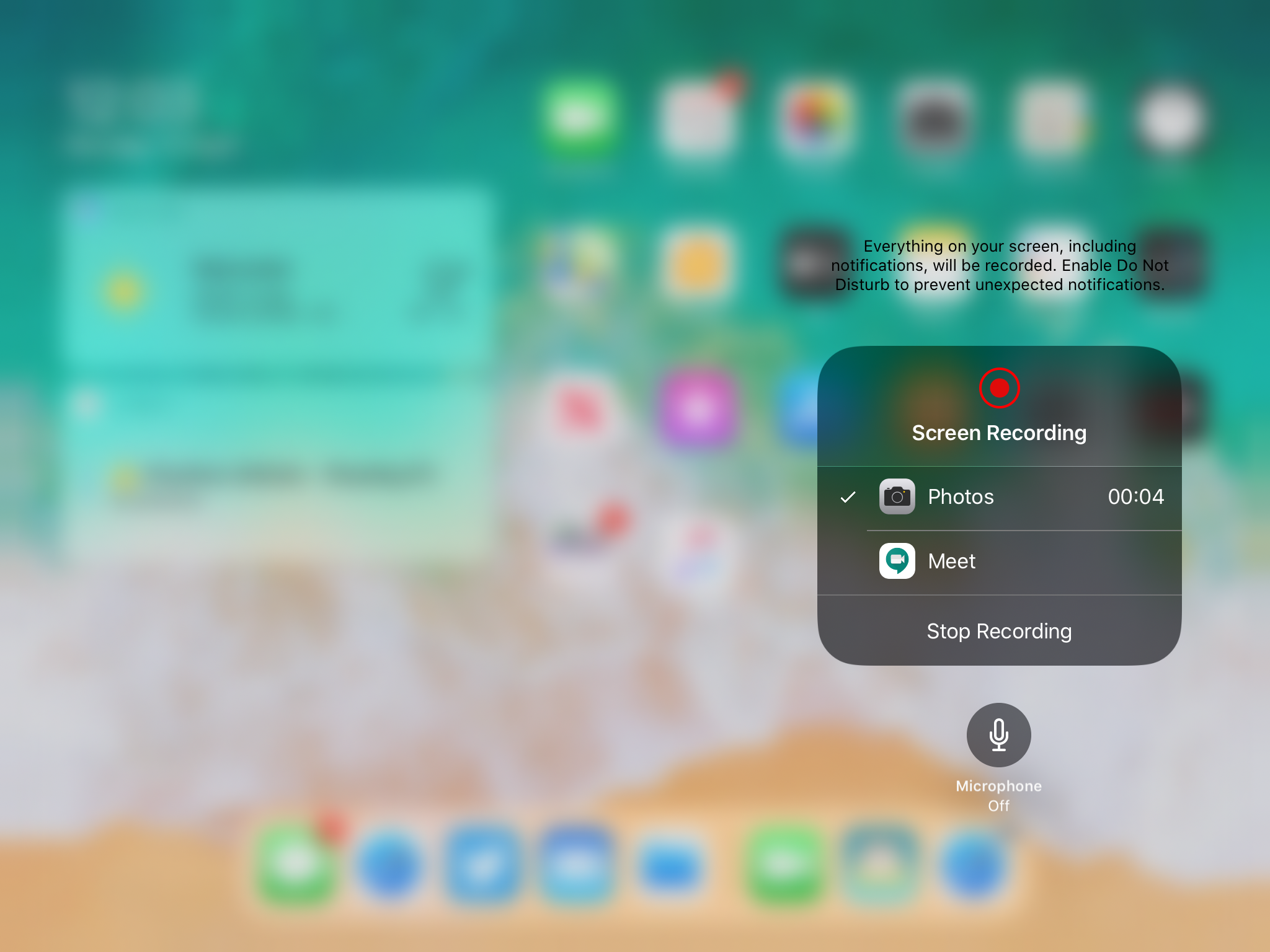
We were also able to put together three sessions regarding the best way to create pre-recorded lessons. Again simplicity was key here, and it turned out that simply using either the iPad or MacBook screen record function was a hugely popular concept for teachers. Screen record does what it says on the tin; records exactly what you do on your device but with the added bonus of being able to record instructions over the top.
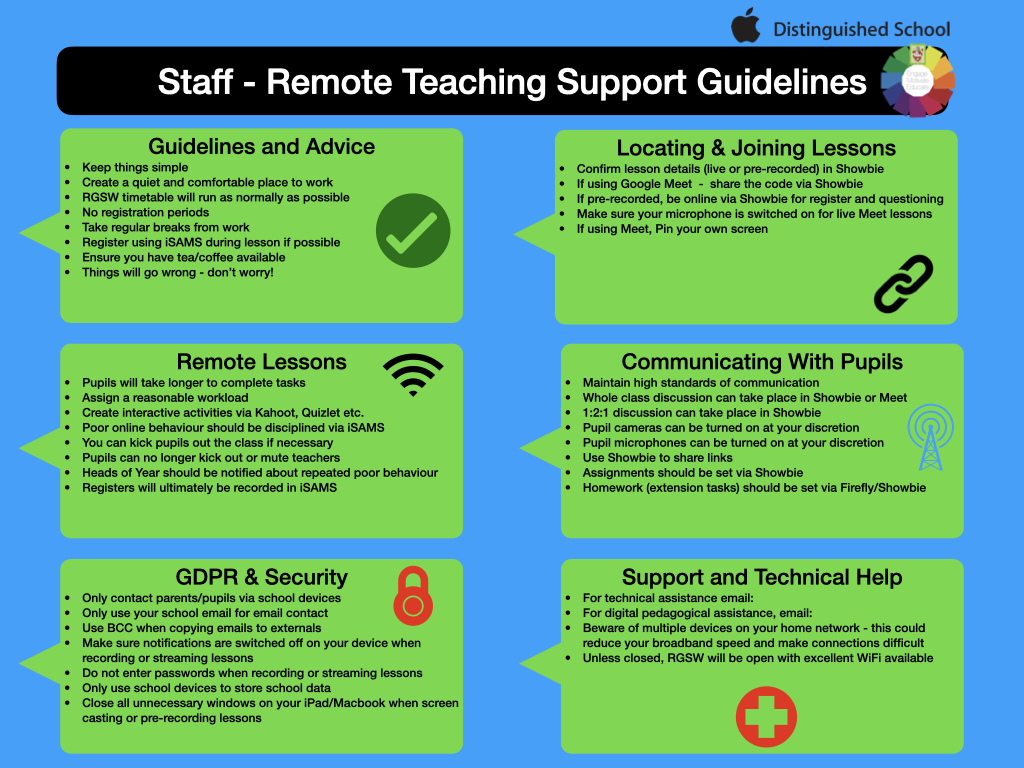
This meant teachers could use Notability or KeyNote to model work, record explanations and then post to Showbie. Another advantage of this concept was that lessons could be created and then shared more than once, thus saving time. One considerable point worth reiterating here is in relation to GDPR; it is extremely important that notifications are turned off when recording, passwords are not entered and only windows that teachers wish to be shared were open. We also put together a graphic to help:
Guidelines for Pupils
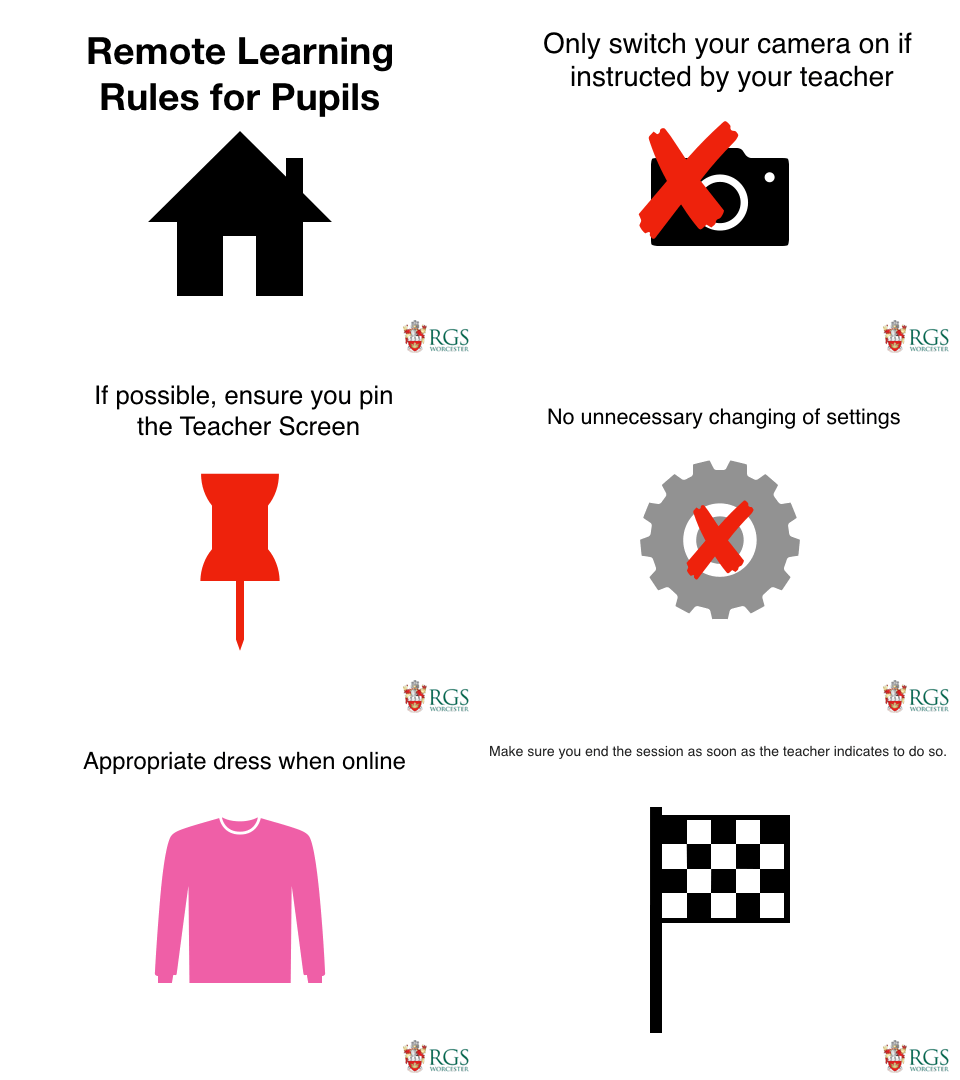
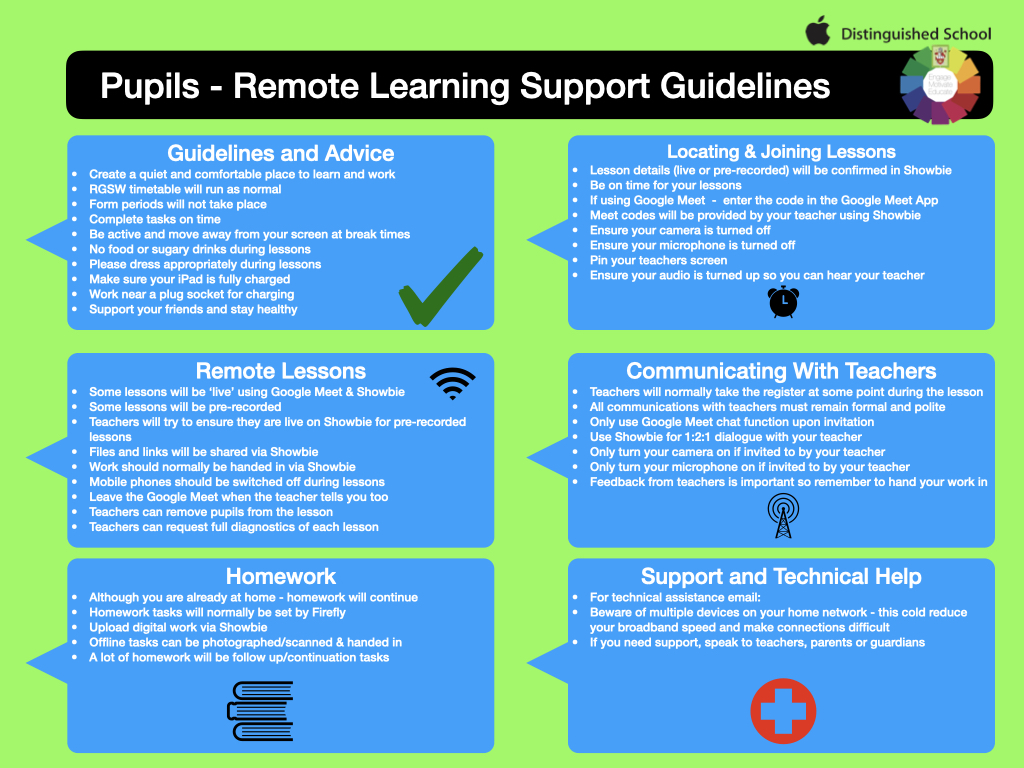
Equally as important was getting a firm and clear message to pupils about our expectations for their behaviour when participating in remote learning. Indeed, we put together a presentation that outlined exactly what they were. Next, we called emergency assemblies so that every single pupil received our message and the presentation was also emailed home to those that were already absent. In these extraordinary times, the support of pupils is essential and we needed to be able to demonstrate just how important their cooperation was when conducting remote lessons.
The rules were also put on our Trilby TV digital signage screens across the school and emailed to all pupils, along with these remote-learning guidelines that were also shared with all parents and guardians.
In Practice
On Monday 23rd March 2020, all UK schools were closed to pupils, other than for those children of Key Workers whose parents needed to continue working in the fight against COVID-19. This unprecedented move meant that, for the first time in over 1300 years of history, lessons at RGS Worcester were not taking place at the school. Instead, teachers were conducting lessons remotely, to pupils in all corners of Worcestershire via digital platforms. I was among the teachers that taught in the first period this morning at 8:45am, hopeful that all our hard work would pay off.
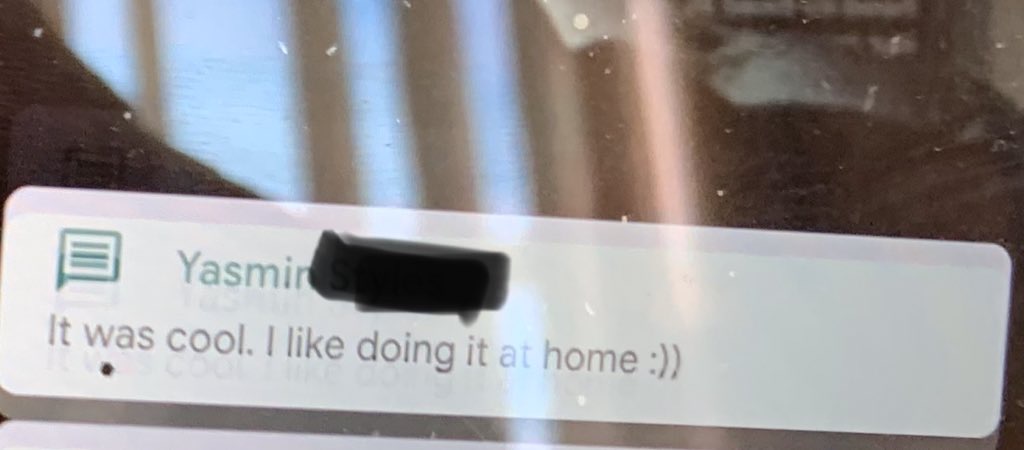
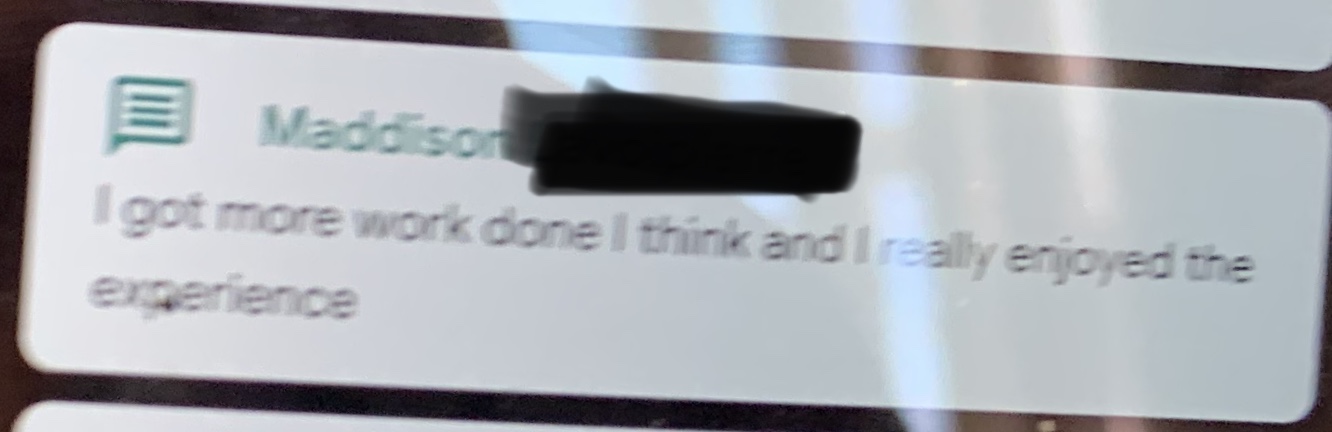
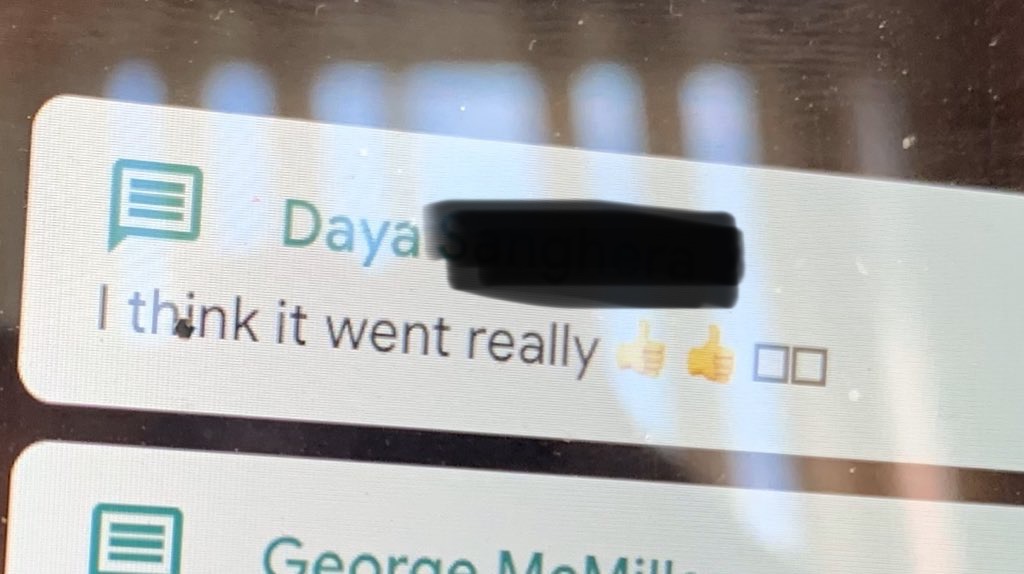
I taught y7 and y8 Computer Science and was happy with how the lessons went; the pupils were brilliant. They followed the rules immaculately (as far as I could tell), they even asked permission to use the toilet! Tasks and resources were pre-loaded in to Showbie so they had scaffolded work to complete and they were able to ask question through the chat function in Google Meet. This proved a little tricky to monitor so I adjusted to only allow questions at certain times. The ‘Thumbs-Up/Down’ emoji was used to check visibility, sound and comprehension of instruction but on occasion, I allowed selected student cameras to be switched on so they could mirror their screens to model work. It was the same with microphones; they were allowed on when messaging was not proving fruitful to address misunderstanding or miscomprehension. Generally, pupils seemed to enjoy the lessons and the only issue was connectivity for pupils with poor WiFi. However, none was so bad that pupils couldn’t progress. I asked for some feedback at the end of the lessons:
Staff Feedback
I also asked for feedback from staff so we can look to make changes if things are not working or if things are going well, so we could share good practice. Here are a few selected comments:
“It was great – I’ve taught 4 lessons from Y7 through to Y13, all live and kids were great.”
“Have a list of pupils to hand so you can ask questions – “Jess put you mic on and answer “ everyone gets a chance then as I forget who’s there.”
“We played a Kahoot via google meet!”
“I preloaded Showbie and this worked well. First 5 minutes on google meet saying hello, registering and explaining task, then being available to answer questions via google meet or Showbie class discussion, work uploaded at the end. Students well behaved.”
“Between them Year 4&5 have sent me 126 messages on the class chat! I’m exhausted”\
“I’ve taught all of Year 9 this morning – have to say they were really good! It’s a little unnerving to be talking with no “visual feedback” from faces, but touch wood, they all said they understood what we’ve done – we shall see!”
“I had mixed experiences today. Y8 was a live Google Meet lesson but GH and OH were unable to see it hear me. They had been OK in Geography though. I was planning to do the lesson on my whiteboard in the classroom but had to do it on Explain everything and put it onto Showbie so GH and OH could access it.”
“All resources were preloaded to Showbie and further details were also on Planner. Students in Y7 shared their short essays at the end of the lesson. I asked for volunteers and, when asked to do so, they turned on their mic and read to the rest of us. Many others sent positive chat comments to congratulate them afterwards.”
“Y10 helped one another as we wrote a complex essay together and told me we should rename ourselves RadioEnglish as it was like calling in to a talk show!”
Conclusions
So, it is very early days in what promises to be a long battle vs COVID-19, where teachers stand on the very front line. However, after seeing how the education community has come together over the last few weeks, I am certain it is a fight we WILL win. The extraordinary efforts by schools to ensure learning continues in adversity, have been nothing short of miraculous. The power of education should never be underestimated and teachers yet again have proven that in the most unusual of circumstances, they can react, learn and adjust to ensure provision continues.


 Learn. Teach. Repeat...