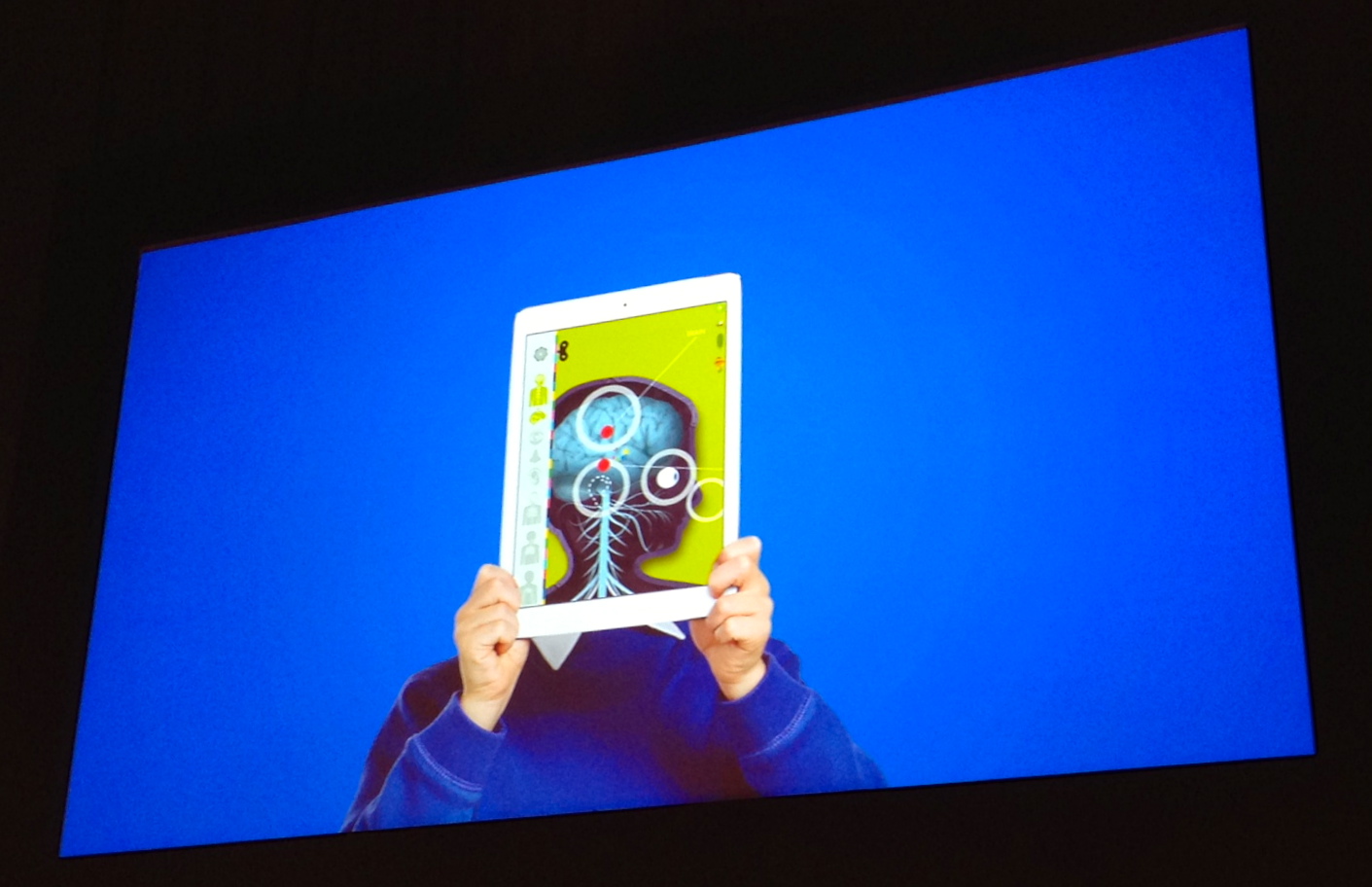
Apple Leadership Summit, King’s Cross, London.

photo-1

I‘m writing this blog post on my sleek new iPad Air whilst sitting on the new High Speed Rail link between St Pancras and Rochester. Before I moved to France, back in 2008, neither of these tasks would have been possible. Indeed, the suggestion of “typing on a tablet” would have led to questions of one’s sanity. However, only six years later, over 20m of UK citizens will be using a tablet device in 2014 and we are witnessing a revolution take place in educational faculties world-wide.

As educators, we know better than most that things change. We also know that many a technological fad has come and gone. Perhaps though, it is the aforementioned tablet, (of the digital variety) that has provided the opportunity to change the very foundations of what constitutes a ‘normal’ classroom. As documented by Ken Robinson, many aspects of schooling are still recognisable from their origins in Victorian, Industrial Britain. Thankfully, most other aspects of society have moved forward and despite the best efforts of Mr Gove to thwart creativity in the classroom, the inspirational pupils, teachers and schools presenting at the Apple Leadership Summit, are moving things forward in education.

First, we heard from some fellow ADE’s (Apple Distinguished Educators) about what they have been up to at their respective schools. It was great to see some familiar faces from the ADE institute in Cork last year and their stories continue to be inspirational. Then it was the turn of the schools. We were fortunate enough to hear from teachers and pupils from Hove Park School who showed us how they had used Keynote and the iPad camera to create superb poetry. This may not initially sound like the redefinition of learning, however the collaboration, feedback and peer review aspects of the projects would not be anywhere near as fluid without the use of iPads. Furthermore, the pupils enthusiasm towards their work, and indeed their digital expertise, holds further testament to the use of mobile devices.

Next it was the turn of Flitch Green to blow our minds with their use of iMovie. Head teacher, Nathan Lowe, was supported by pupils and staff alike as they demonstrated how they used iMovie to assist with creative writing. Again, the confidence and expertise of the pupils shone through and indeed, one Year Six pupil, who had previously struggled with writing, was able to stand up and read a short extract of his superb work to a room packed full of delegates. It is, of course, the instruction of teachers that ensured this progression, but having an iPad available offers simple, but highly effective, creative opportunities to learners of all abilities.

More inspiration came in the shape of two schools that are blazing a trail with regard to innovation in the classroom. Derek Trimmer and Niel McLeod walked us through the remarkable journey of Hove Park School. The story itself is incredible enough; in 2009 it was a failing school with only 29% of students getting 5 A-C’s at GCSE. Five years later it is a hub of creativity where over 60% of students recently passed more than 5 A-C’s. The improvement in grades is one thing, however what resonated most with me was the additional data they were able to share. Data that confirmed the positive impact iPads had had on learning. Interestingly, a team from my school, King’s Rochester, had recently visited both Flitch Green and Hove Park and can vouch for the transformational learning that is taking place.

The story behind Lever House Primary School in Lancashire was equally inspiring. Headteacher, John Hurst, presented his vision and how learning at his school had been transformed by a pedagogical approach that ensured learners inquired, questioned and created. He recognised that the teacher was no longer the fountain of all knowledge and that students should be able to engage with the internet, learn how to search safely and effectively cross reference their discoveries. The iPad had been instrumental in delivering this approach but John’s vision went even further. He held school blogging, and publishing content to a global audience, in high esteem as well. He also believed in empowering some students to actually moderate the posts. This is an initiative we tried in Monaco and was highly successful, despite the fact it went against the grain of popular opinion.

In conclusion, it was hugely refreshing to hear that other, highly successful and innovative schools and their leaders shared similar ideals, values and pedagogical principles to me. The schools and their pupils were shining examples of how it can be done if the vision and belief are there. The leaders behind the vision knew from the outset they would face opposition, challenges and make mistakes along their journey. Nevertheless, they knew that these risks were worth taking in their quest to ensure that the learning experiences of their students were relevant, engaging, meaningful and FUN!


The Only Way is Essex

Essex is home to Russell Brand, Blur and The Prodigy  – three very different but equally seminal artists. It is also the abode of two fantastic schools that we were fortunate enough to visit. Another early start, but with much more agreeable traffic than our last adventure, we arrived in the beautiful town of Coggeshall with enough time for a quick coffee before visiting the high achieving (and over-subscribed) local secondary school, Honywood Community Science Academy.

We were given a very warm welcome by Lou Sanderson, Assistant Head and Apple Distinguished Educator, whom I had met briefly before in Cork at the ADE institute earlier this year. However, at the Fota Island Hotel,  I did not have the opportunity to hear about the remarkable journey that both her and her school had been on – this was my opportunity to catch up! Honywood has a unique and inspiring approach to education. It is a learner focused school that is proud of its growth mindset. It encourages all its learners (not pupils/students!) to challenge themselves on a daily basis and see what they can do with the curriculum. Testing is kept to an absolute minimum and upon joining the school, no notice is taken of previous test results and classes are set randomly, there are no ability groups to be found anywhere. The focus at Honywood is firmly and proudly fixed on learning, not on grades. Yet sadly enough, it is still with grades that Ofsted and many others judge schools, so how have Honywood’s GCSE results shaped up? Well, in 2012, 72% of all pupils attained five GCSEs grade A* to C;  an increase of four percentage points since 2011 and 14% above the national average.

This visionary and successful approach to learning has also embraced technology. Following a survey,  the learners themselves selected the iPad to supplement their learning and it was those same learners who then took us on a fascinating, impromptu tour of the school. We saw music, art, English, drama and ICT lessons and saw children working individually, in pairs and in groups. Furthermore, in the overwhelming majority of cases we saw learners that were motivated, focused and enjoying their work. We took the opportunity to speak to the children and one comment that particularly resonated with me came from a Y7 student; “we feel independent here, we don’t just get told what to do”. As Dostoyevsky famously wrote, “To go wrong in one’s own way is better then to go right in someone else’s” and that culture of challenge, independence and enquiry was evident throughout the whole school.

Our second visit of the day took as to Flitch Green Academy, a Primary school in the heart of the local community and with an impressive and exciting story to share. We were met by the Headteacher, Nathan Lowe, another ADE who had begun his headship in 2012. Flitch Green had decided not to go down the 1:2:1 route, instead having a bank of 10 iPads available per class. Like the learners at Honywood, the children at Flitch Green did not see the iPad as a novelty, it was simply part of their everyday learning experience. Another similarity between the two schools was the emphasis on thinking and challenge. Nathan and his predecessor had been extremely impressed by the work of Chris Quigley  and therefore ensured that their curriculum was creative and vibrant and explored the “why?” Technology was simply a cog in this innovative approach. There is no doubt that learning at Flitch is enhanced by the use of Plasma TV’s, Apple TV and iPads, but they merely form part of the overall vision of ensuring that, upon leaving the school, children are empowered with relevant life skills that build confidence and potential.

Our visit to Essex was inspiring in many ways; visionary teachers and wonderful children that were genuinely proud of their schools. The learners were filled with enthusiasm and effortlessly used cutting edge technology to facilitate the learner-focused pedagogy that underpinned the success of both educational establishments. The Christmas break will now allow us time for further reflection and provide an opportunity for our plans to develop and progress, as we continue to make positive steps forward.

A Journey In The Right Direction

Teaching takes you in many directions and provides you with unique experiences. From toxic chemical cloud drills to games of Bunny Bunny, the old cliche that no two days are the same really does carry weight in our exhilarating profession. Thursday 28th November was no exception.

A party of six left King’s Rochester at 7am to visit three Sussex schools; Hove ParkRoedean and Hurspierpoint. All three schools had been recommended by Solutions Inc; an Apple re-seller in Hove with whom we are building links. Solutions have already visited King’s to complete a WiFi survey and kindly invited us to speak to, and learn from, a selection of schools that were on different stages of their tech adoption. The M25 insisted that we took the scenic route to The South Coast and after an enjoyable journey through the countryside, we arrived at our first destination…

Hove Park is a school on the up. In August 2012, they were placed first in Brighton and Hove for most improved schools, being 2nd in the South East and 12th Nationally. Their results have also coincided with a innovative approach to learning by introducing iPads in the day-to-day life of the school. Our meeting was led by Deputy Head and Business Manager, Niel McLeod, and he walked us through the journey Hove Park had been on thus far. Niel confirmed that any tech adoption scheme must be driven from the SLT. Without support from the top, any initiative will be unlikely to succeed. He also talked of the importance of not forcing change; allowing teachers the freedom to develop their own pedagogy around devices is crucial. Teachers who had been happily and successfully teaching for 25 years sometimes did not see the need to incorporate iPads into their lessons and were often afraid to do so. However, putting the devices in their hands long before the students got hold of them, alleviated some of this pressure. Furthermore, the use of drop-in workshops and Digital Leaders had also helped with the transition, and had the dual effect of empowering students. Indeed, it was the evidence collected form the students that demonstrated why their iPad adoption scheme was working – and why the effort that teachers had made to was so worth it – enjoyment of lessons had increased by over 60% whilst remarkably, negative behaviour had actually reduced by 56%.

One of the most famous girls schools in Brighton.

One of the most famous girls schools in Brighton. (Photo credit: Wikipedia)

Next on the hit-list was historic Roedean. Perched elegently on the chalk cliffs, East of Brighton, Roedean has also recently rolled out iPads and we heard their story via their incredibly knowledgeable network manager, Shayne Parker. Shayne stated that before considering a tech roll out of any kind, it was essential to have future-proofed and reliable WiFi infrastructure underpinning the operation. It was interesting to hear how Roedean had overcome issues such as the thickness of the historic walls; this is something that needs to be considered in many of the buildings at King’s. The majority of Roedean’s students are boarders, and this was another factor in their decision to get a high quality infrastructure and device management system. Many of the girls at Roedean come from overseas so access to tools such as Skype and Facebook is imperative, but of course there are e-safety concerns that needed to be addressed. Roedean used Smoothwall as their content filtering solution and Shayne could not have been more complimentary. Regarding the iPads themselves, Roedean’s workflow solution used Apple TV and Office 365; a tech ecosystem I had not come across before, but one that clearly worked very well and one that could also work at King’s with our Windows-based network.

Our last stop was Hurstpeirpoint College. Orginally founded in 1849, Hurst boasts the oldest Shakespeare society in existence but fuses tradition with cutting edge technology deployment and the inspirational Deputy Head, Vickie Bacon, filled us in on the schools iPad story. Their 1:2:1 scheme was in its third year and was clearly deeply entrenched in everyday school life and the curriculum. Like the other two schools, Hurst was becoming increasingly involved with iTunesU and has also introduced iPod touches in the Pre-Prep. Technology was clearly a huge part of the school’s vision and after seeing a stunning impromptu Keynote presentation from a Y8 pupil, the positive effect it was having on learning was obvious. Indeed, as soon as the presentation had finished the pupil smiled and said “I had a lot of fun making that”. The fact that the subject was ‘corresponding angles’ says a lot about how, when facilitated correctly, technology can make learning about even the most mundane of subjects, engaging and exciting.

The drive home was filled with much excitement; we had learned so much and were enthused about the adventures ahead. Each school was at a different stage of their respective journeys, and each school was carving a path that was unique and personalised to best enhance the experience of their learners. Nevertheless, each school shared a vision to ensure their students were benefitting from the remarkable technology that is now increasingly a part of everyday life. It is now our job up to use this valuable experience and formulate our own plans for the future at King’s.

ICT Matters – Outcomes…

Last time I attended some non-BETT related CPD in the UK, it concerned how to make an effective shrine in the classroom! Thankfully, in my new dwellings at King’s Rochester, there is no need for a shrine, yet there is a need for development and progression; this was reaffirmed at the EdExec ICT Matters conference in Islington on Wednesday.

However, unlike recent exciting trips to BETT, or teachmeets that have left me inspired, I did not leave the conference with a list of must-have Apps or creative ideas to experiment with in the classroom. Instead, I left with some very useful information about a variety of, well, ICT Matters!

First, we enjoyed a revealing keynote speech from Ofsted’s David Brown, the chief HMI for ICT. Now, on paper this probably sounds as exciting as watching paint dry but in reality, it was very informative. We learnt what both outstanding and unsatisfactory looked like from an Ofsted point of view. In fact, it was refreshing to hear that “There isn’t a right or a wrong way, rather it depends on your outcomes”. Too often do we get caught up in debates about iPads vs laptops, or IOS vs Windows. Every school is different. What works in one, may not work in another. Effectiveness is what really counts. If Ofsted are open minded about this then all the better. However, Mr Brown also stated that a school could be judged as ‘outstanding´, despite having no ICT! In this day and age, I find that ridiculous.

Of particular interest was the next seminar “Ensuring effective tablet implementation”, led by Valerie Thompson, chief executive of the e-learning foundation. Although I have direct experience of rolling out iPads, the context in Monte Carlo was very different. Students were from very affluent families and, after a survey, I discovered over 95% of them had personal iPads that they were willing to bring to school; the ISM BYOiPad scheme was born. Things are different in the UK, although tablets are becoming more common, a recent study suggested only 31.3% of the UK population were regular tablet users and certainly, that will differ greatly in each school. Therefore, a different strategy to any potential tech roll-out at my new school would be required and this seminar gave a great overview. High up the priority list was infrastructure; future proofed, scaleable WiFi. This is something we are seriously investigating at King’s and will underpin any successful future tech roll out.

Next up was, “The Ethics of BYOD: how they will impact your approach”, presented by Steve Warburton (@stevewn). BYOD has many fans and many critics, again though, the outcome of any given project is what really matters. For example, our BYOiPad scheme in Monaco was (and still is) hugely successful. It was underpinned with rigorous policies that were clearly spelt out to the students, furthermore E-Safety was prioritised within the curriculum. We developed a culture in which children knew their boundaries and rarely crossed them. On those occasions that problems did occur, they were quickly picked up on and dealt with. The children knew that they were responsible for the success of the initiative and responded accordingly. The outcomes by which we measured the success were the ingenuity, creativity, application and E-awareness of technology by our students . Back to BYOD itself, whether we follow a similar path at King’s is a discussion for the future, but if we do the tips and questions provided by Mr Warburton could prove to be invaluable.

Finally, “New approaches to ed-tech procurement” by Crispin Weston (@crispinweston) provided plenty of food for thought. He argued that many current theories of ed-tech and technology-enhanced learning are not working as well as they might and therefore we may need to think again. However, in my mind the theme of ‘different horses for different courses’ cropped up again. For every school that has an iPad scheme that has boosted creative opportunities, student moral and whole-school workflow, there is one in which all the iPads have been broken and the schools budget is deep in the red.

As far as I am concerned there is NO argument against having ICT taught in UK schools. My theory therefore, would be that the secret to success of tech adoption is an open and agreed vision of tech deployment and outcomes. This requires detailed, contextualised planning that considers the expertise and needs of staff and students and thankfully that is something we are in the process of undertaking at King’s. How that success is measured however, is an entirely different matter. The ‘outcomes’ that  David Brown spoke of were never quantified, and the fact that schools with no tech could be judged as outstanding suggests they are probably more likely to be based on SATs/GCSE or A-Level results rather than anything else.

A New Perspective…

I am writing this blog post from my new classroom at King’s Rochester after leaving the International School of Monaco in June. In my old classroom, in Monte Carlo, one of the first things people commented on was the view. You could see the whole of Monaco and the surrounding towns of Beausoleil and La Turbie perched perilously on the steep beginnings of the imposing, but stunning Alpine mountain range. My new classroom view had a lot to live up to…

20130826-205957.jpg

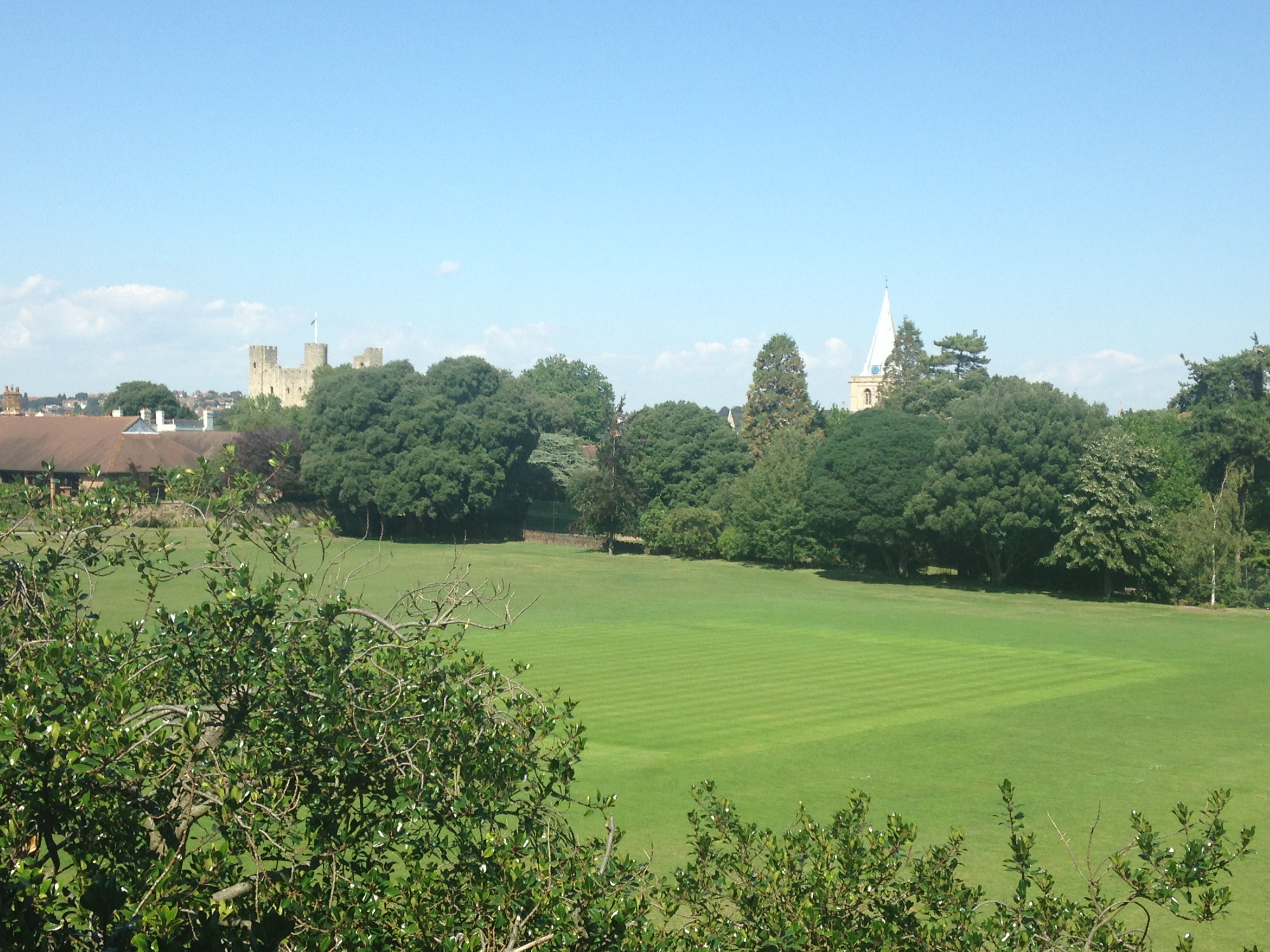
However, it is with great pleasure that I can announce the offerings outside my new place of work are absolutely fantastic, and very quintessentially English. The pristine cricket green is wonderfully complemented by an amazing backdrop of historic Rochester Castle and Cathedral. King's Rochester View

These two very different, but equally pleasing, classroom perspectives are in a sense metaphorical of my new job. I have a very exciting challenge to redefine the use of technology. At present I have a computer lab of 18 Dell desktops running Windows 2003 and (wait for it) no WiFi! All this after I helped to establish 1:2:1 iPad deployment, MacBook Pro’s for student use and fibre optic WiFi at ISM. Two very different set-ups, but two equally exciting challenges.

Current tech-limitations aside, there is one obvious, but incredible opportunity at King’s to redefine learning; school blogging. I have already contacted educational blogs guru, John Sutton, to establish King’s Blog Site which will be operational from September. This is the first step of many in my quest to complement the ancient tradition of King’s with the transformational learning opportunities provided by the remarkable technology we have at our disposal.

ADE Institute, 2013. What’s the Story?

Stories have been told for over 40,000 years. They form a huge part of cultures, traditions, religions and families, and are something we share daily with each other across the globe. The story of the ADE institute in Cork is, of course, one of innovation, creativity, reflection; all things you would expect from an Apple event such as this. However, the real story lies in the people that attended the event – The Apple Distinguished Educators of Europe, the UAE and India.

The week provided plenty of opportunities to meet and talk with like-minded educators from all over the world. There was a huge range of different institutions that were represented;  from Kindergarten to University –  all subjects and age ranges were covered, therefore providing unprecedented levels of expertise. Complementing the different backgrounds of the ADE’s at Cork, was one overriding common feature. Every single ADE has used technology to change learning in their schools; therefore every single ADE had a fascinating and informative story to tell.

The story of the (John) Lennon Bus is remarkable, and one that I recommend all educators investigate. Furthermore, attending the event were members of the Californian based Team Duarte, experts in presentation and design. During a highly informative presentation, entitled ‘Resonating Through Contrast’, by founder and CEO, Nancy Duarte, the theme of story-telling was highlighted as essential to any presentation. She analysed how famous speeches by the likes of Martin Luther King and Steve Jobs followed similar patterns, and the story-element contained within them, were vital to their success. However, as fascinating as this was, it was the stories of the ADE’s that I was most interested in and resonated deepest with me.

A major part of the institute was the formation of a PLN with whom work was completed for the rest of the week, I was fortunate enough to begin work with teachers who shared a commonality of thinking differently; formation of our PLN name followed naturally. Team ‘Think Different’ was born. Our PLN contained brilliant teachers from Holland, Sweden and the UK, and all their respective stories were remarkable. I quickly ascertained that I was making game-changing connections with educators who had detailed and highly relevant expertise, skills and ideas that would help me to improve my pedagogy, make me a better teacher and ultimately ensure a positive impact on the students I teach. They were:

Mat Pullen – @Mat6453 | Gavin Smart – @GavinSmart | Jesper Gronlund – @JesperSH |Nick Davies – @TESSEnglish1 |Nick Dempster – @linakerICT |Frans Ittman – @snarfje

Team Think Different

Our stories were shared, and this small group of ADE’s provided encouragement, points for development and a brilliant sense of humour. We bounced ideas, critically examined and resonated with each other, making connections that would last and grow. Already, there is talk of a get-together in the near future. A chance for our story to continue, and for the plot to thicken as we take our next steps together to make positive changes to the lives of the children we teach.

There were many other amazing people at the institute; Marc Faulder, Alan Frame,  Jared Rodgers, Mark Anderson, Daniel Edwards, Lauren Young, Adam Webster, Rebecca Stockley, Jennifer McCoy, Graeme McCafferty, Ghislain Dominé, Ed Charlwood, Wolfgang Soeldner, Tom Riley, Johan Andersson, Carrie Zimmer, Graham Bell, Mark Shillitoe and many, many others, who all shared parts of their stories with me and I also can’t wait to see their next chapters unfold…

“World Class” Education – How will we compare?

I have just returned to the UK, after five years working in International Education, and have read with interest that we can all look forward to a new, “World Class” curriculum, that will “ensure the children of the UK will be able to enjoy the sort of education available to children in other countries.” Sounds great!

However, having never visited or worked in a school in what are regarded as the Worlds best education systems, how can I genuinely compare?

I would love to use Twitter to learn more about the education systems elsewhere in the World and would greatly appreciate some comments from educators, or other interested parties, who work, or have experience of working, in the countries I have started to investigate below.

I have managed to ascertain a few interesting facts; if anyone can verify, correct or indeed add to the information detailed below, I would be eternally grateful!

SINGAPORE

  • Equal emphasis on vocational AND academic qualifications
  • Huge emphasis on raising the quality of its teachers and its education leaders
  • Teach Less > Learn More – moved instruction away from rote memorisation and repetitive tasks
  • Focus on deeper conceptual understanding and problem based learning
  • From 2009 Art, Music and PE all gained a larger role in the overall curriculum
  • Introduced TEACH framework to support teacher-led professional development and work life balance
  • Great care taken to ensure new policies complement the old ones
  • Teachers trained in Singapores most prestigious higher educational institutes

FINLAND

  • Responsibility for Teacher Training lies in Finnish Universities in order to improve quality of teaching
  • Success is a result of a lone, slow and steady process, not a single policy program or administration > each step built sensibly on those that went before
  • United comprehensive education structure and national curriculum guidelines
  • Do not start formal school until they are seven years old; instead remain in play-based pre-schools or “kindergartens” until that age,
  • Key to success – quality of teachers
  • Every 4 years, Government prepares a development plan for education; constantly adapting to the changing needs of the country
  • Focus on:
    • Smaller class sizes
    • Enhancing remediation and special needs training
    • Improve teachers working conditions and develop new opportunities for Professional Development
  • do not begin to study simple fractions, such as halves and quarters, until they are at least seven.

AUSTRALIA

  • De-centralised education system > although there is a common framework for the country’s states and territories
  • Enhanced Professional Development opportunities
  • National Partnership to improve Teacher Training and retention
  • Developed a National Assessment programme and National Curriculum in 2009
  • Slight decline in maths and reading meant a $67 billion infusion into the education system
  • Initiatives targeted ailing school infrastructure and underacheiving students

CANADA

  • No federal level education ministry
  • Strong focus on integration of immigrant children
  • Prior to 2003, Canada had aggressive education reform strategy.  Centralised testing and teacher accountability  deeply alienated teachers and the unions
  • After 2003, teachers were engaged through an agenda THEY played a strong role in designing rather than one imposed on them
  • Established a literary and numeracy team, separate from the ministry, who worked with schools to set high but achievable goals
  • Student success strategy – focused on identifying potential drop outs & providing them with additional help to succeed e.g. new high school majors
  • Government provided funds to schools to hire specialist, designated teachers in problem areas


I will leave you to draw your own conclusions about how our prospective “World Class” curriculum compares to the above. `

Hopefully, comments below will assist us all further in ascertaining the real parallels between these leaders in educational provision and what we will face in schools from September 2014.

Student Portfolios With Evernote

At the end of the school year, every student in the Primary School at The International School of Monaco gets a chance to show a portfolio of their work to their parents. The idea is simple; over the course of the year each class is given a small amount of time to bookmark work they would like to have in their portfolio and write a reflection to accompany it. The reflection should highlight why the work was selected, progression, challenges involved and perhaps how the work could be improved in future. In years gone by this was done using a combination of paper, ink and a photocopier. With the technology we have available today, far more efficient and interactive options are available.

Last year I tried QR codes, and despite being eye-catching, they were far too time consuming and inefficient. Therefore this year, I decided to use Evernote – an App that I had read a lot about but never really got to grips with myself; it turned out to be a very worthwhile shift.

NOTEBOOKS:

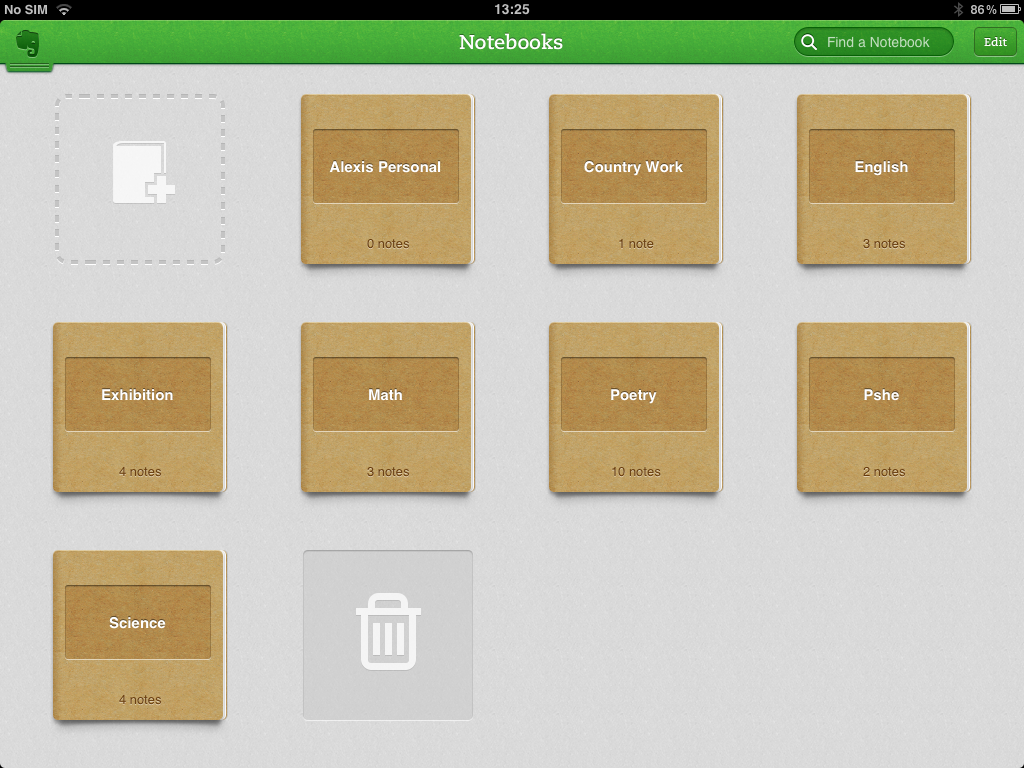
As a class, we decided that using ‘Notebooks’ would be the best way to organise the portfolio (this could also done using the ‘tag’ feature). The children then decided upon their own subject-based categories:

Evernote Notebook Picture

NOTES:

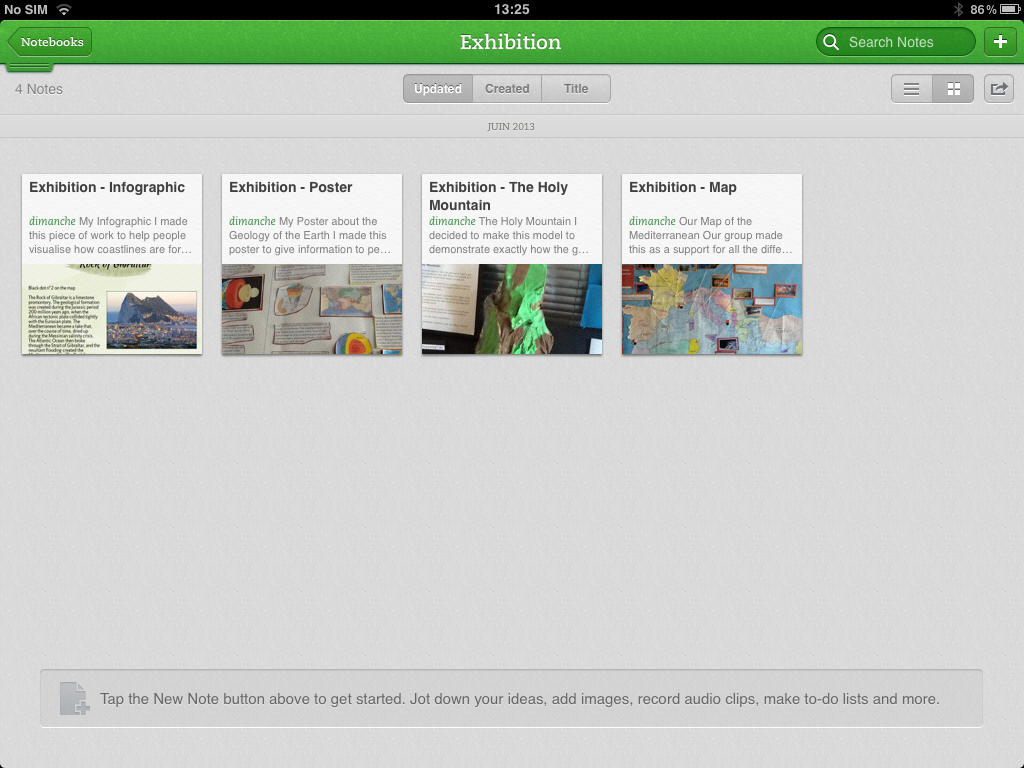
As you can see, underneath the title of each notebook, the number of notes within the notebook is displayed. That simply means how many pieces of work were selected in each subject. If you click on a notebook, you can then select from the notes within. For example, by clicking on ‘Exhibition‘ in the example above you would arrive at the following screen

Notes Inside notebook

As you can see the navigation is simple and intuitive for both the students and whoever maybe observing the portfolio.

USING PHOTOGRAPHS/SOUND RECORDING:

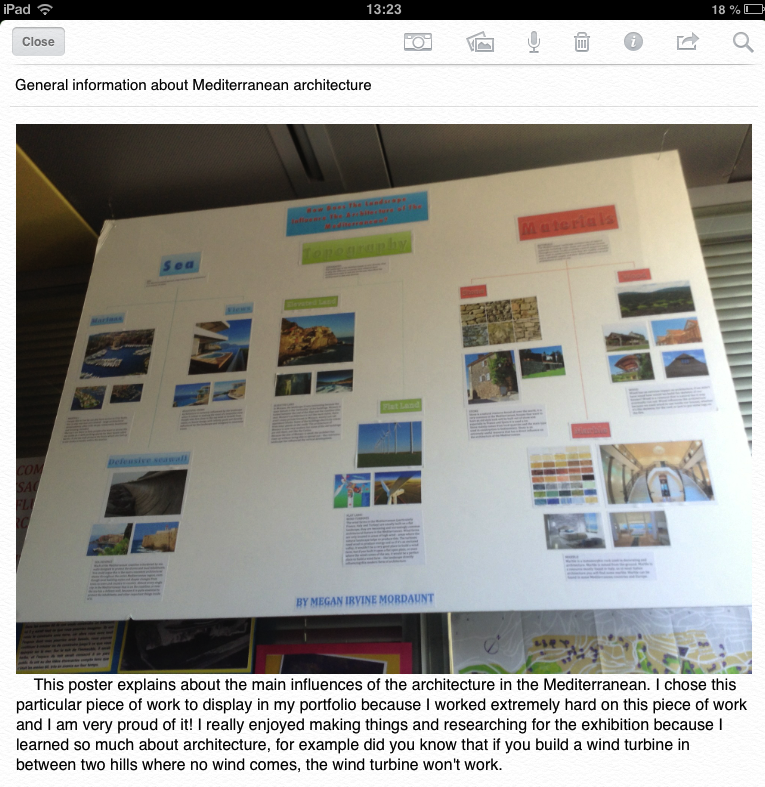
The real brilliance of Evernote though lies in the variety of ways that you can create notes. You can simply add text, or take a photo or add a photo from your photo library. You can even add a sound recorrding. The Photo function, in particular, proved incredibly useful when including artwork, book or display work and adding a reflection.

EN with Photo and reflection

SYNCING WITH EVERNOTE:

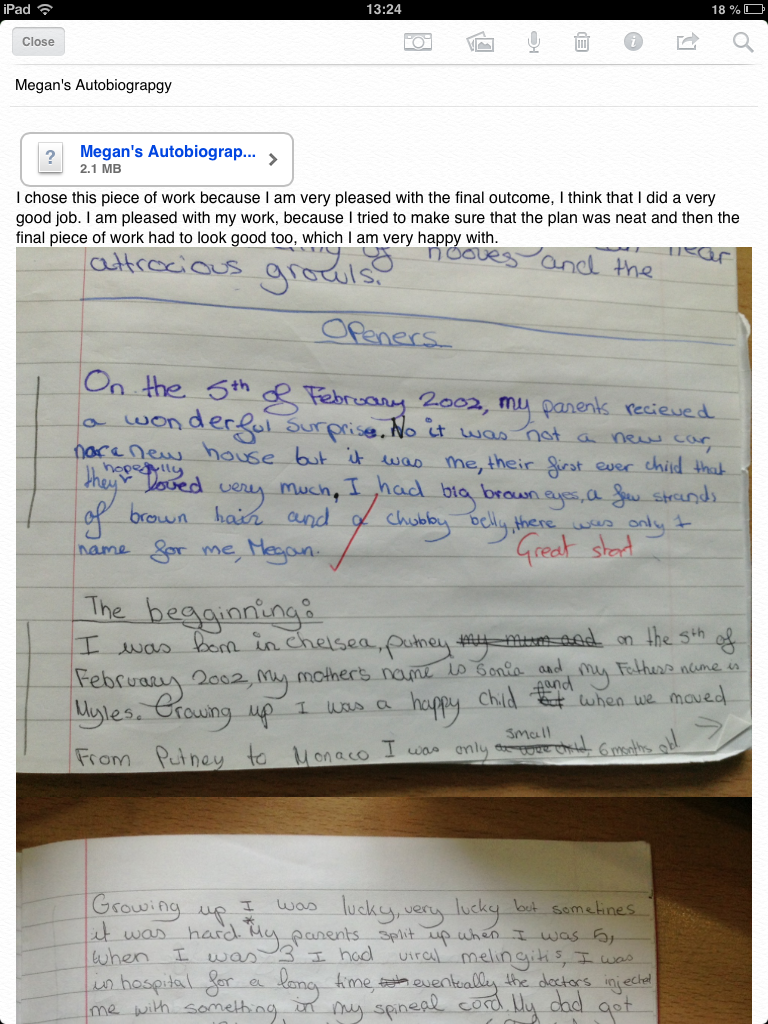
Another superb function of Evernote is its ability to sync with other Apps; ensuring productivity and workflow. This is particularly useful in portfolios when used in conjunction with the photo function. Students can then easily show how work has progressed from the original draft-work into a final publication. Here is an example of a note synced with Bookcreator, along with the original work and the reflection.

EN Draft + link to BookC

Evernote also syncs with Apps such Explain Everything and iMovie to name but a few. This capability meant that the children’s digital work was easily connected within their Evernote portfolio. In cases where the work was unable to be synced within Evernote, for example with Prezi or YouTube, we simply put a link within the note that took you directly to their work within the respective iPad App. In other words, as long as you had the Prezi App, the transition between reflection and student-work remained very smooth.

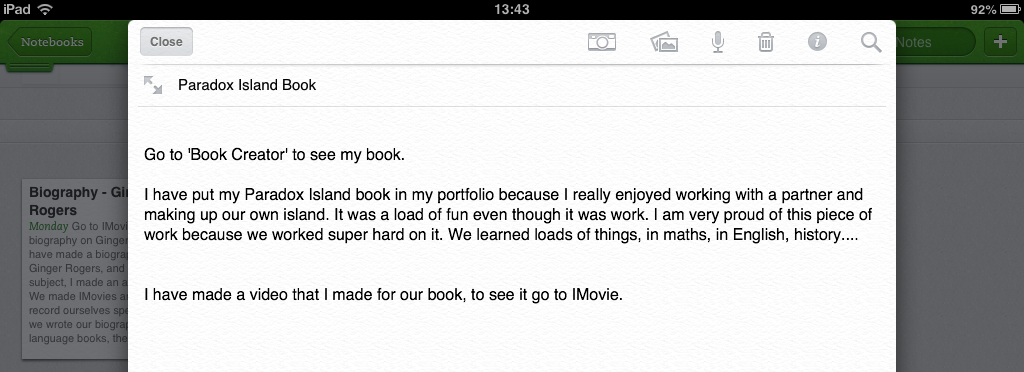
The only hang up with Evernote, for projects like this, is the limit in file size (60mb), unless you pay $5 a month for the premium version for 1GB of storage. Again though, there is a simple workaround. Our students simply put in a disclaimer at the top of their reflections that told the reader to navigate directly to the App in which the work was contained. For example:

Photo 20-06-2013 13 43 07

MY REFLECTIONS!

The shift to Evernote was a complete success. The children were able to collate examples of work from all subject areas (some even had PE videos) in a user-friendly, easy navigable and cohesive App. They synchronization between apps is superb and ensures workflow is optimized.  Many of the students themselves commented on how they enjoyed using the App and how they would, in the future, use it again for both school and non-school related work. I echo their sentiments entirely.

The Next Episode…

Things change. As an educator absorbed in a sometimes daunting but fascinating world of technology in education, I know that only too well. It is with very fond memories that I am saying goodbye to The International School of Monaco and taking up a new position, as Head of ICT, at King’s Prep School, Rochester, UK.

Five years at ISM have been challenging, rewarding and memorable. As someone whose career is based around learning, I have been astonished by the amount I have personally learnt as I begin to understand the significance ICT can have on education; the barriers it removes and the borders it breaks. Those five years at ISM have seen the incredible emergence of blogs, iPads and web-tools in the classroom, and with it what would appear a genuine mind-shift in education towards creativity, at least in some quarters.

Twitter itself has been one of the most radical tools with regard to my own understanding of learning. Without it my knowledge could still be limited to CPD sessions run by The County Council, in which if you were lucky, you’d get 30 minutes of valuable insight and the rest was all about the sausage rolls. 30 minutes on twitter and you can be overwhelmed with innovative ideas and invaluable resources. Its with great excitement and anticipation that I look forward to continuing to learn from Twitter whilst attending TeachMeets and other such teacher-led CPD opportunities to continue my personal learning journey.

And learn is what I am going to have to do. I will leaving the comfort of my IOS, Apple environment, in which iPads and digital tools have become firmly embedded in everyday classroom life, to a predominantly Windows environment where ICT is still taught discreetly. Its a very different setup with very different challenges, but is something I am incredibly excited about undertaking. Furthermore, it is something that I feel far more confident in doing, knowing that I have a huge network of education professionals from around the World to call upon for help and advice when I, inevitably, will need it.

ICT… “When Will The Novelty Wear Off?”

Every month or so, the ICT committee at The International School of Monaco meets to discuss all things ICT related. The meetings are (as far as meetings go) always enjoyable. They are progressive, forward thinking and normally focus on what the most important aspect of any school should be; learning.

The most recent meeting followed this pattern. @JenOFee and myself presented our major findings from this years BETT show. The Prezi itself was very specific to ISM, so I won’t bore you with that, however the last slide is worth mentioning. In it I detailed some key points – they were:

  • ISM is facing in the right direction, but we have to keep on walking
  • Multitude of fantastic resources out there; we must choose wisely
  • Professional development is imperative to the success of ICT at ISM
  • To move forward we have to improve our infrastructure (wifi, bandwith etc)
  • Technology is NOT going to disappear, rather it will become ever more prevalent in education

It is the last point that I would like to discuss now; the fact that technology is here to stay. No one with any credibility, in any sector, can doubt the ever-gaining prevalence ICT plays in our society. For example, right now I am having a conversation on Facebook Messenger on Android, whilst writing a blog article on my Macbook at the same time as watching Bradford vs Swansea on my iPad through a VPN connection thrown onto my television via Apple TV. Nothing other than a normal Sunday afternoon, nothing novel whatsoever.

Nevertheless, during the aforementioned ICT meeting, a questions was raised after myself and @ISMscience introduced the awesome iTunesU & iBooks author: “That looks great, but when will the novelty wear off?”

The question demonstrates the misconception of technology; that it is a novelty. I mean, when schools order science texts books, is their novelty time-frame questioned? I’d like to hazard a guess that is isn’t and if it was, the answer would be weeks, if not days. Furthermore, what may seem novel to older generations is normality to todays children. The science books created on iBook Author  by @ISMscience are a case in point. They contained stunning HD images, video content and other multimedia. Therefore, I suppose, they are more ‘novel’ than their text book equivalent. However, their real value lies not in their novelty value but in the fact they are relevant, customizable, inituitive and frankly what our learners deserve; teachers using technology to maximise their learning experience.

In Monaco certainly, most children over ten have smartphones. Whether this is a good thing or not is not todays argument, moreover this point details what our children are used to, what they expect. They are used to watching and learning through video, they are used to reading digital content, they are used to being able to ascertain knowledge at the touch of a button. Therefore, handing them a monologue, paper text book is simply irrelevant and out of date. Indeed, from my experience of text book based learning and the text books I have chanced upon, they are also enough to put them off a subject for life.

ICT (can we still use that term?) in schools is not a novelty; it is here to stay. The BYOiPad scheme, that is now in its third year at ISM, highlights this point precisely. During the first week, the Y6 students eagerly awaited instruction to use their iPads, clearly enjoying ‘the novelty’ of using their devices, in school, for the first time. Now, the iPads are charged, packed and ready on their desks as a matter of course. They are simply seen as an essential part of the day to day learning process in a 21st Century School. As they move into Middle and Secondary School, it would be completely illogical for them to suddenly leave the iPads at home and revert to mundane text book studying. Fundamentally, it would be doing our learners a disservice. Instead, they should be using their iPads (or whatever technology is best suited at that point in time to enhance the learning experience) to log onto their iTunes U course and access the accompanying engaging, relevant and personalised iBook.

With new technologies, there will always be a natural amount of novelty attached. Any educator who uses technology purely for this reason should reconsider doing so. Any educator who harnesses the power of technologies, new or old, and uses it to ensure learners are motivated, captivated, involved and empowered in their learning should rest assured that their students will, one day, thank them for it.