
Tomorrow, on my first official day at my new school, I am introducing school-blogging to the staff. To support my presentation I put together the following Prezi. If you find yourself purveying the huge benefits of school-blogging , you may find elements of it useful.
Author Archives: John Jones
A New Perspective…
I am writing this blog post from my new classroom at King’s Rochester after leaving the International School of Monaco in June. In my old classroom, in Monte Carlo, one of the first things people commented on was the view. You could see the whole of Monaco and the surrounding towns of Beausoleil and La Turbie perched perilously on the steep beginnings of the imposing, but stunning Alpine mountain range. My new classroom view had a lot to live up to…

However, it is with great pleasure that I can announce the offerings outside my new place of work are absolutely fantastic, and very quintessentially English. The pristine cricket green is wonderfully complemented by an amazing backdrop of historic Rochester Castle and Cathedral. 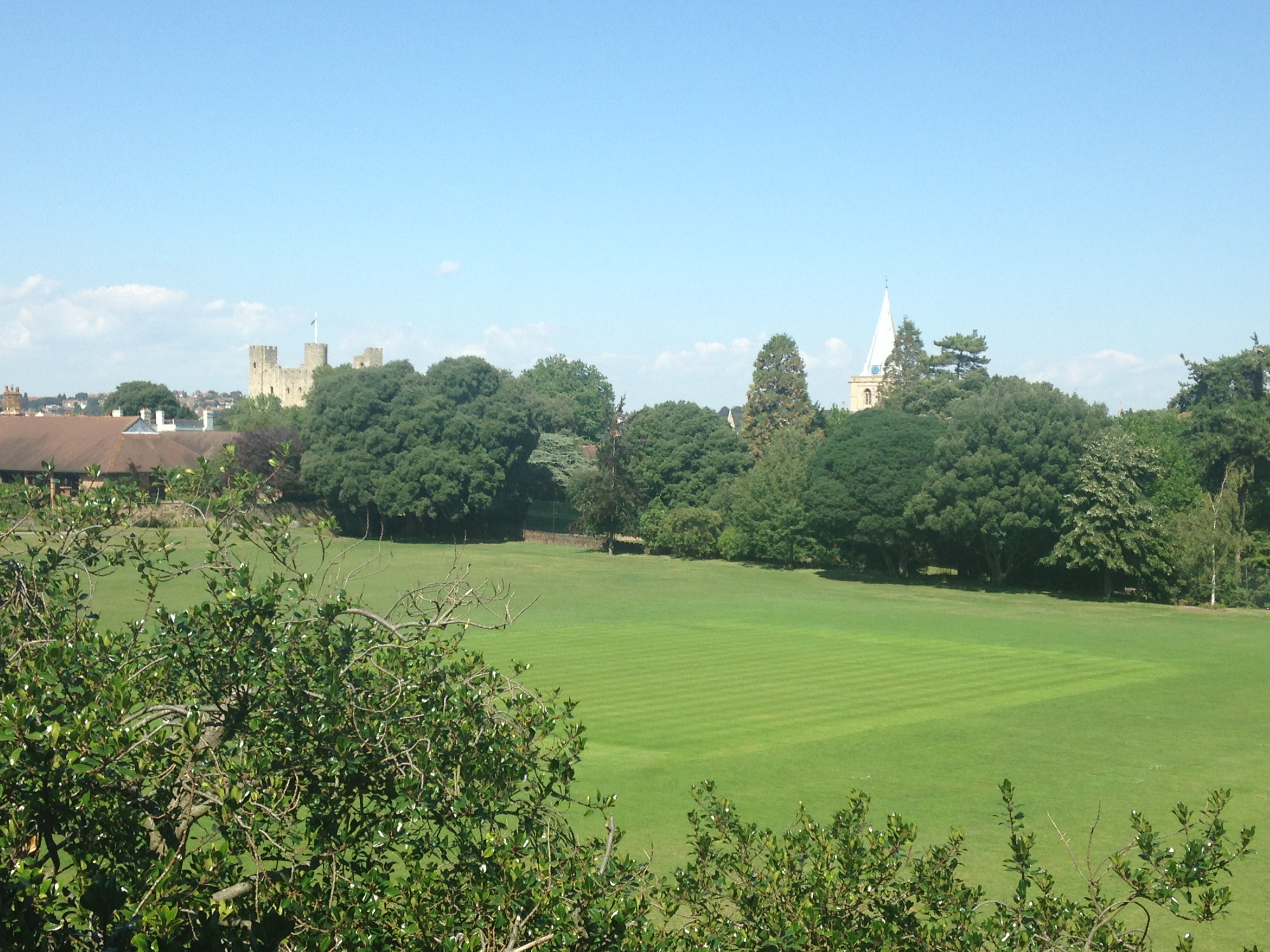
These two very different, but equally pleasing, classroom perspectives are in a sense metaphorical of my new job. I have a very exciting challenge to redefine the use of technology. At present I have a computer lab of 18 Dell desktops running Windows 2003 and (wait for it) no WiFi! All this after I helped to establish 1:2:1 iPad deployment, MacBook Pro’s for student use and fibre optic WiFi at ISM. Two very different set-ups, but two equally exciting challenges.
Current tech-limitations aside, there is one obvious, but incredible opportunity at King’s to redefine learning; school blogging. I have already contacted educational blogs guru, John Sutton, to establish King’s Blog Site which will be operational from September. This is the first step of many in my quest to complement the ancient tradition of King’s with the transformational learning opportunities provided by the remarkable technology we have at our disposal.
ADE Institute, 2013. What’s the Story?
Stories have been told for over 40,000 years. They form a huge part of cultures, traditions, religions and families, and are something we share daily with each other across the globe. The story of the ADE institute in Cork is, of course, one of innovation, creativity, reflection; all things you would expect from an Apple event such as this. However, the real story lies in the people that attended the event – The Apple Distinguished Educators of Europe, the UAE and India.
The week provided plenty of opportunities to meet and talk with like-minded educators from all over the world. There was a huge range of different institutions that were represented; from Kindergarten to University – all subjects and age ranges were covered, therefore providing unprecedented levels of expertise. Complementing the different backgrounds of the ADE’s at Cork, was one overriding common feature. Every single ADE has used technology to change learning in their schools; therefore every single ADE had a fascinating and informative story to tell.
The story of the (John) Lennon Bus is remarkable, and one that I recommend all educators investigate. Furthermore, attending the event were members of the Californian based Team Duarte, experts in presentation and design. During a highly informative presentation, entitled ‘Resonating Through Contrast’, by founder and CEO, Nancy Duarte, the theme of story-telling was highlighted as essential to any presentation. She analysed how famous speeches by the likes of Martin Luther King and Steve Jobs followed similar patterns, and the story-element contained within them, were vital to their success. However, as fascinating as this was, it was the stories of the ADE’s that I was most interested in and resonated deepest with me.
A major part of the institute was the formation of a PLN with whom work was completed for the rest of the week, I was fortunate enough to begin work with teachers who shared a commonality of thinking differently; formation of our PLN name followed naturally. Team ‘Think Different’ was born. Our PLN contained brilliant teachers from Holland, Sweden and the UK, and all their respective stories were remarkable. I quickly ascertained that I was making game-changing connections with educators who had detailed and highly relevant expertise, skills and ideas that would help me to improve my pedagogy, make me a better teacher and ultimately ensure a positive impact on the students I teach. They were:
Mat Pullen – @Mat6453 | Gavin Smart – @GavinSmart | Jesper Gronlund – @JesperSH |Nick Davies – @TESSEnglish1 |Nick Dempster – @linakerICT |Frans Ittman – @snarfje

Our stories were shared, and this small group of ADE’s provided encouragement, points for development and a brilliant sense of humour. We bounced ideas, critically examined and resonated with each other, making connections that would last and grow. Already, there is talk of a get-together in the near future. A chance for our story to continue, and for the plot to thicken as we take our next steps together to make positive changes to the lives of the children we teach.
There were many other amazing people at the institute; Marc Faulder, Alan Frame, Jared Rodgers, Mark Anderson, Daniel Edwards, Lauren Young, Adam Webster, Rebecca Stockley, Jennifer McCoy, Graeme McCafferty, Ghislain Dominé, Ed Charlwood, Wolfgang Soeldner, Tom Riley, Johan Andersson, Carrie Zimmer, Graham Bell, Mark Shillitoe and many, many others, who all shared parts of their stories with me and I also can’t wait to see their next chapters unfold…
“World Class” Education – How will we compare?
I have just returned to the UK, after five years working in International Education, and have read with interest that we can all look forward to a new, “World Class” curriculum, that will “ensure the children of the UK will be able to enjoy the sort of education available to children in other countries.” Sounds great!
However, having never visited or worked in a school in what are regarded as the Worlds best education systems, how can I genuinely compare?
I would love to use Twitter to learn more about the education systems elsewhere in the World and would greatly appreciate some comments from educators, or other interested parties, who work, or have experience of working, in the countries I have started to investigate below.
I have managed to ascertain a few interesting facts; if anyone can verify, correct or indeed add to the information detailed below, I would be eternally grateful!
SINGAPORE
- Equal emphasis on vocational AND academic qualifications
- Huge emphasis on raising the quality of its teachers and its education leaders
- Teach Less > Learn More – moved instruction away from rote memorisation and repetitive tasks
- Focus on deeper conceptual understanding and problem based learning
- From 2009 Art, Music and PE all gained a larger role in the overall curriculum
- Introduced TEACH framework to support teacher-led professional development and work life balance
- Great care taken to ensure new policies complement the old ones
- Teachers trained in Singapores most prestigious higher educational institutes
FINLAND
- Responsibility for Teacher Training lies in Finnish Universities in order to improve quality of teaching
- Success is a result of a lone, slow and steady process, not a single policy program or administration > each step built sensibly on those that went before
- United comprehensive education structure and national curriculum guidelines
- Do not start formal school until they are seven years old; instead remain in play-based pre-schools or “kindergartens” until that age,
- Key to success – quality of teachers
- Every 4 years, Government prepares a development plan for education; constantly adapting to the changing needs of the country
- Focus on:
- Smaller class sizes
- Enhancing remediation and special needs training
- Improve teachers working conditions and develop new opportunities for Professional Development
- do not begin to study simple fractions, such as halves and quarters, until they are at least seven.
AUSTRALIA
- De-centralised education system > although there is a common framework for the country’s states and territories
- Enhanced Professional Development opportunities
- National Partnership to improve Teacher Training and retention
- Developed a National Assessment programme and National Curriculum in 2009
- Slight decline in maths and reading meant a $67 billion infusion into the education system
- Initiatives targeted ailing school infrastructure and underacheiving students
CANADA
- No federal level education ministry
- Strong focus on integration of immigrant children
- Prior to 2003, Canada had aggressive education reform strategy. Centralised testing and teacher accountability deeply alienated teachers and the unions
- After 2003, teachers were engaged through an agenda THEY played a strong role in designing rather than one imposed on them
- Established a literary and numeracy team, separate from the ministry, who worked with schools to set high but achievable goals
- Student success strategy – focused on identifying potential drop outs & providing them with additional help to succeed e.g. new high school majors
- Government provided funds to schools to hire specialist, designated teachers in problem areas
I will leave you to draw your own conclusions about how our prospective “World Class” curriculum compares to the above. `
Hopefully, comments below will assist us all further in ascertaining the real parallels between these leaders in educational provision and what we will face in schools from September 2014.
Student Portfolios With Evernote
At the end of the school year, every student in the Primary School at The International School of Monaco gets a chance to show a portfolio of their work to their parents. The idea is simple; over the course of the year each class is given a small amount of time to bookmark work they would like to have in their portfolio and write a reflection to accompany it. The reflection should highlight why the work was selected, progression, challenges involved and perhaps how the work could be improved in future. In years gone by this was done using a combination of paper, ink and a photocopier. With the technology we have available today, far more efficient and interactive options are available.
Last year I tried QR codes, and despite being eye-catching, they were far too time consuming and inefficient. Therefore this year, I decided to use Evernote – an App that I had read a lot about but never really got to grips with myself; it turned out to be a very worthwhile shift.
NOTEBOOKS:
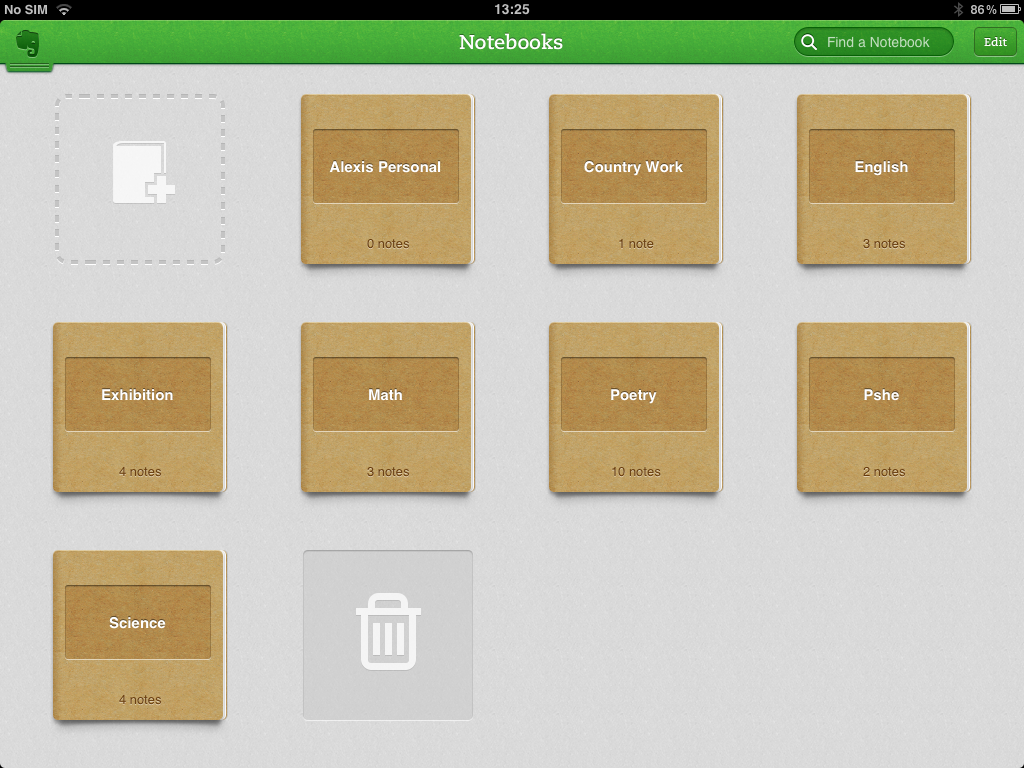
As a class, we decided that using ‘Notebooks’ would be the best way to organise the portfolio (this could also done using the ‘tag’ feature). The children then decided upon their own subject-based categories:
NOTES:
As you can see, underneath the title of each notebook, the number of notes within the notebook is displayed. That simply means how many pieces of work were selected in each subject. If you click on a notebook, you can then select from the notes within. For example, by clicking on ‘Exhibition‘ in the example above you would arrive at the following screen
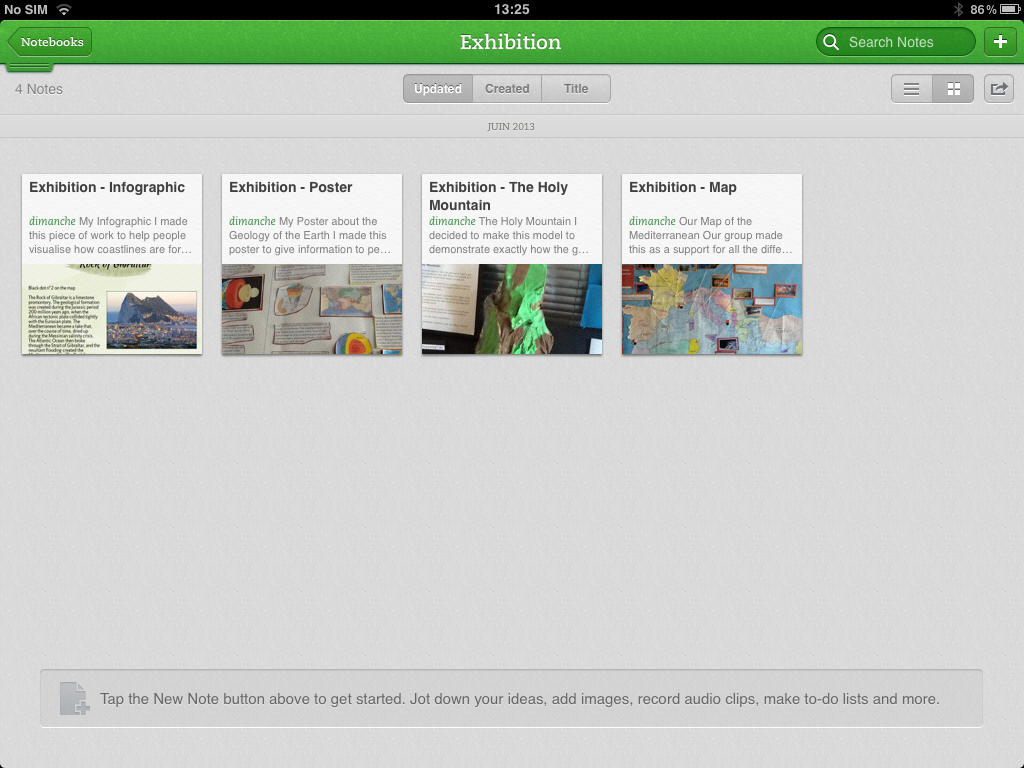
As you can see the navigation is simple and intuitive for both the students and whoever maybe observing the portfolio.
USING PHOTOGRAPHS/SOUND RECORDING:
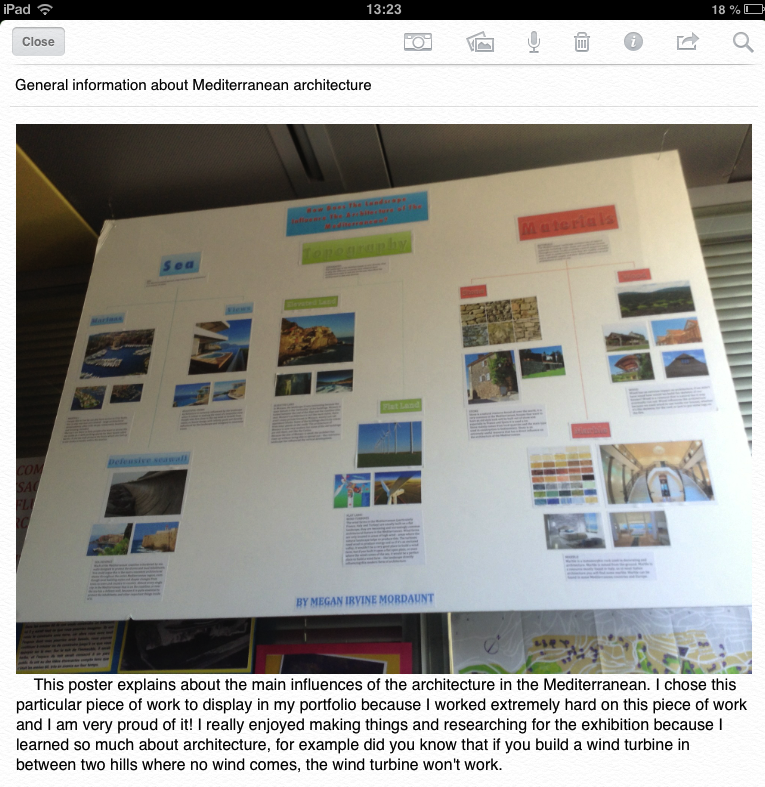
The real brilliance of Evernote though lies in the variety of ways that you can create notes. You can simply add text, or take a photo or add a photo from your photo library. You can even add a sound recorrding. The Photo function, in particular, proved incredibly useful when including artwork, book or display work and adding a reflection.
SYNCING WITH EVERNOTE:
Another superb function of Evernote is its ability to sync with other Apps; ensuring productivity and workflow. This is particularly useful in portfolios when used in conjunction with the photo function. Students can then easily show how work has progressed from the original draft-work into a final publication. Here is an example of a note synced with Bookcreator, along with the original work and the reflection.
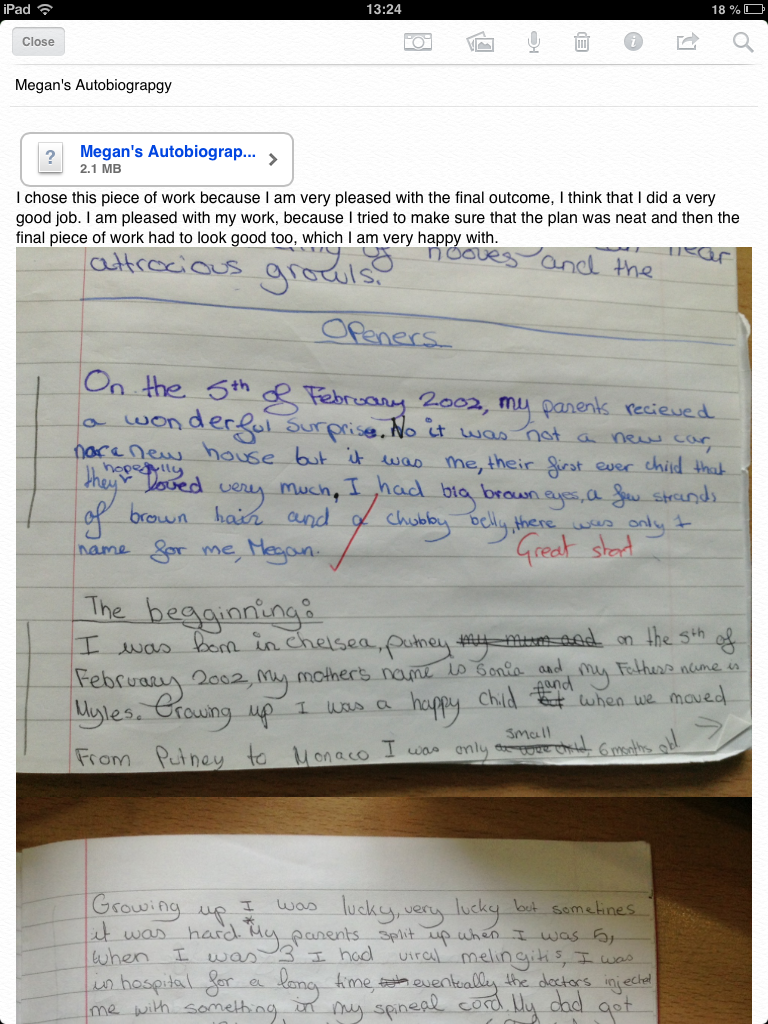
Evernote also syncs with Apps such Explain Everything and iMovie to name but a few. This capability meant that the children’s digital work was easily connected within their Evernote portfolio. In cases where the work was unable to be synced within Evernote, for example with Prezi or YouTube, we simply put a link within the note that took you directly to their work within the respective iPad App. In other words, as long as you had the Prezi App, the transition between reflection and student-work remained very smooth.
The only hang up with Evernote, for projects like this, is the limit in file size (60mb), unless you pay $5 a month for the premium version for 1GB of storage. Again though, there is a simple workaround. Our students simply put in a disclaimer at the top of their reflections that told the reader to navigate directly to the App in which the work was contained. For example:
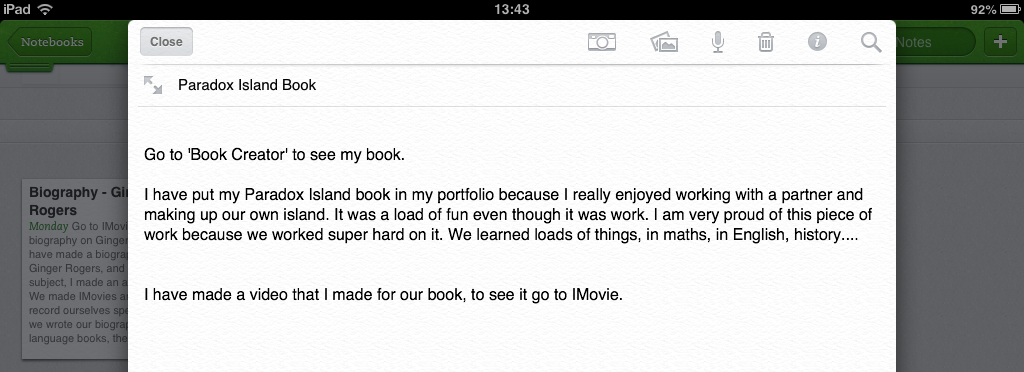
MY REFLECTIONS!
The shift to Evernote was a complete success. The children were able to collate examples of work from all subject areas (some even had PE videos) in a user-friendly, easy navigable and cohesive App. They synchronization between apps is superb and ensures workflow is optimized. Many of the students themselves commented on how they enjoyed using the App and how they would, in the future, use it again for both school and non-school related work. I echo their sentiments entirely.
Solids, Liquids & Gases
My last ever topic at The International School of Monaco is Solids, Liquids & Gases and I really want to ensure I leave ISM with a bang… A more appropriate subject could not have been selected! Here is what we are getting up to:
HARLEM STATE OF MATTER:
To start the project off we had a class discussion about how molecules behaved in the major three states of matter. We then came up with a great way of demonstrating this which also kick-started their interest – The Harlem State (Of matter)!
This gave the children a pretty could grounding from which they could build their knowledge through interesting investigations and experiments.
EXPLAIN EVERYTHING
Next I wanted to get to grips with the awesome Explain Everything app. After a quick intro and demonstration of its capabilities, I simply set the task of researching a little further & explaining what they understood about the states of matter using the app! This is an example of the results:
We then used some easy, simple but fun experiment ideas from the brilliant Birmingham Science museum ThinkTank site. They have a monthly, ‘Experiment of the month’ and group them into sections that fit neatly with KS2 science expectations. Again, the ever-flexible Explain Everything proved a brilliant way to plan, hypothesize, film the experiment, collate results and conclude. Here is an example:
Does Air Have Mass?
Finally, we also looked at The Water Cycle. Again, Explain Everything was used by the students to demonstrate their understanding. Take a look at these two high quality examples; both done by 10 year old children…
The Next Episode…
Things change. As an educator absorbed in a sometimes daunting but fascinating world of technology in education, I know that only too well. It is with very fond memories that I am saying goodbye to The International School of Monaco and taking up a new position, as Head of ICT, at King’s Prep School, Rochester, UK.
Five years at ISM have been challenging, rewarding and memorable. As someone whose career is based around learning, I have been astonished by the amount I have personally learnt as I begin to understand the significance ICT can have on education; the barriers it removes and the borders it breaks. Those five years at ISM have seen the incredible emergence of blogs, iPads and web-tools in the classroom, and with it what would appear a genuine mind-shift in education towards creativity, at least in some quarters.
Twitter itself has been one of the most radical tools with regard to my own understanding of learning. Without it my knowledge could still be limited to CPD sessions run by The County Council, in which if you were lucky, you’d get 30 minutes of valuable insight and the rest was all about the sausage rolls. 30 minutes on twitter and you can be overwhelmed with innovative ideas and invaluable resources. Its with great excitement and anticipation that I look forward to continuing to learn from Twitter whilst attending TeachMeets and other such teacher-led CPD opportunities to continue my personal learning journey.
And learn is what I am going to have to do. I will leaving the comfort of my IOS, Apple environment, in which iPads and digital tools have become firmly embedded in everyday classroom life, to a predominantly Windows environment where ICT is still taught discreetly. Its a very different setup with very different challenges, but is something I am incredibly excited about undertaking. Furthermore, it is something that I feel far more confident in doing, knowing that I have a huge network of education professionals from around the World to call upon for help and advice when I, inevitably, will need it.
ICT… “When Will The Novelty Wear Off?”
Every month or so, the ICT committee at The International School of Monaco meets to discuss all things ICT related. The meetings are (as far as meetings go) always enjoyable. They are progressive, forward thinking and normally focus on what the most important aspect of any school should be; learning.
The most recent meeting followed this pattern. @JenOFee and myself presented our major findings from this years BETT show. The Prezi itself was very specific to ISM, so I won’t bore you with that, however the last slide is worth mentioning. In it I detailed some key points – they were:
- ISM is facing in the right direction, but we have to keep on walking
- Multitude of fantastic resources out there; we must choose wisely
- Professional development is imperative to the success of ICT at ISM
- To move forward we have to improve our infrastructure (wifi, bandwith etc)
- Technology is NOT going to disappear, rather it will become ever more prevalent in education
It is the last point that I would like to discuss now; the fact that technology is here to stay. No one with any credibility, in any sector, can doubt the ever-gaining prevalence ICT plays in our society. For example, right now I am having a conversation on Facebook Messenger on Android, whilst writing a blog article on my Macbook at the same time as watching Bradford vs Swansea on my iPad through a VPN connection thrown onto my television via Apple TV. Nothing other than a normal Sunday afternoon, nothing novel whatsoever.
Nevertheless, during the aforementioned ICT meeting, a questions was raised after myself and @ISMscience introduced the awesome iTunesU & iBooks author: “That looks great, but when will the novelty wear off?”
The question demonstrates the misconception of technology; that it is a novelty. I mean, when schools order science texts books, is their novelty time-frame questioned? I’d like to hazard a guess that is isn’t and if it was, the answer would be weeks, if not days. Furthermore, what may seem novel to older generations is normality to todays children. The science books created on iBook Author by @ISMscience are a case in point. They contained stunning HD images, video content and other multimedia. Therefore, I suppose, they are more ‘novel’ than their text book equivalent. However, their real value lies not in their novelty value but in the fact they are relevant, customizable, inituitive and frankly what our learners deserve; teachers using technology to maximise their learning experience.
In Monaco certainly, most children over ten have smartphones. Whether this is a good thing or not is not todays argument, moreover this point details what our children are used to, what they expect. They are used to watching and learning through video, they are used to reading digital content, they are used to being able to ascertain knowledge at the touch of a button. Therefore, handing them a monologue, paper text book is simply irrelevant and out of date. Indeed, from my experience of text book based learning and the text books I have chanced upon, they are also enough to put them off a subject for life.
ICT (can we still use that term?) in schools is not a novelty; it is here to stay. The BYOiPad scheme, that is now in its third year at ISM, highlights this point precisely. During the first week, the Y6 students eagerly awaited instruction to use their iPads, clearly enjoying ‘the novelty’ of using their devices, in school, for the first time. Now, the iPads are charged, packed and ready on their desks as a matter of course. They are simply seen as an essential part of the day to day learning process in a 21st Century School. As they move into Middle and Secondary School, it would be completely illogical for them to suddenly leave the iPads at home and revert to mundane text book studying. Fundamentally, it would be doing our learners a disservice. Instead, they should be using their iPads (or whatever technology is best suited at that point in time to enhance the learning experience) to log onto their iTunes U course and access the accompanying engaging, relevant and personalised iBook.
With new technologies, there will always be a natural amount of novelty attached. Any educator who uses technology purely for this reason should reconsider doing so. Any educator who harnesses the power of technologies, new or old, and uses it to ensure learners are motivated, captivated, involved and empowered in their learning should rest assured that their students will, one day, thank them for it.
Reflections on BETT 2013
It has been nearly a week since returning from BETT 2013, and only now have I managed to find five minutes to jot down a few words about the experience. For the first time, BETT took place at the Excel Arena in East London, a stones throw from where my Grandmother grew up and from where her house was destroyed during the Blitz. How things in the Royal Victoria Dock have changed.
The Excel Arena is huge, and the space was really appreciated as there was notably more room to get around. Similarly, the exhibitors appeared to have more space with which to exhibit their vast array of ed-tech products. The seminar halls were also located in amongst the exhibitors and were much easier to find than those of the Excel Arena’s ageing predecessor; Olympia in West London.
For the first time too, I learnt more from the exhibitors stands than I did from the official seminars at BETT. Professor Brian Cox aside, the presentations I saw in the designated arenas were either uninspiring, or rehashing what I already knew. Worst of all were the poorly disguised attempts to sell products. However, by wandering around the exhibitor stands I was able to talk with, and listen to interesting, dedicated and innovative educators such as Julia Skinner, Mark Anderson, Martin Burrett, David Mitchell and John Sutton. I even managed to deliver a presentation of my own on the Acer stand about the blogging journey at ISM.
The exhibitors themselves also has some absolute gems to take back to ISM and make some proposals. For example, I have already set up a MediaCore account for our school. Mediacore is a video platform for schools in which you can upload your own content or content from other sources such as YouTube or Vimeo. All comments and adverts are automatically removed and clearly this is a a huge advantage in an educational environment. Most impressive of its features was its Mobile App with which you can upload iMovies straight from your iPad’s camera roll!
Another product that really got my imagination flowing was the School Radio stand. Although perhaps a luxury, getting a school radio station would be amazing! We could perform plays, broadcast news, broadcast live music, broadcast interviews, create adverts etc – the options are endless! Conjuring up the €7000 to get the system may prove a bit tricky though. I’ll work on it…
Overall, BETT was a fantastic experience. Its great to meet so many likeminded people; successfully restoring all faith in my drive to ensure learning is at a premium by exploring and utilizing the myriad of creative, meaningful and enjoyable ways in which technology can enhance it.
To Blog Or Not To Blog; the ISM Question.
At BETT 2013, I delivered a presentation about the blogging journey at ISM. Here is the accompanying Prezi.
 Learn. Teach. Repeat...